NEWS


In the 2000–2001 academic year, a bold idea took root at the University of Oklahoma: to build an institute dedicated to helping students with disabilities chart meaningful, self-directed paths into adulthood. Twenty-five years later, the Zarrow Institute on Transition and Self-Determination has grown into a nationally recognized engine of research, training, and programs that change outcomes and culture.
Kendra Williams-Diehm, Ph.D., director since 2018, reflects on a quarter‑century of impact. “Everyone has the right to fulfill their life in a meaningful way. Our job is to make sure students with disabilities are achieving those goals, too.”
A Founding Vision Rooted in Opportunity
The Institute’s origins trace back to Jack and Maxine Zarrow, whose family has a deeply personal commitment to disability inclusion. Seeing their own child’s opportunities constrained, they envisioned a center that would focus squarely on helping students with disabilities prepare for life beyond school, whether that meant higher education, employment, or community participation.
“They wanted an institute focused on what we could do while students are still in school to prepare them for life after,” said Jim Martin, Ph.D., the Institute’s founding director. “Even for those who made it to college, the jump into employment remained a steep climb.”
The need was clear. Research in the 1980s and 1990s showed that too many students with disabilities were finishing high school only to face unemployment, isolation, and limited opportunities.
“Public education spent billions to improve the lives of people with disabilities,” Martin noted, “but when they left high school, their lives too often became ones of unemployment, loneliness, and isolation.”
When Martin saw the inaugural job posting, he recognized a once-in-a-career chance to build something transformative.
“The [employment] ad was unlike any I’d ever seen—to create a center that could go in one of two directions: postsecondary education or youth in public schools,” he said. “In our field, it was the best position in the country. Well, in the world, actually.”
Arriving in 2000 with an administrative assistant and a vision, Martin helped shape not only the Institute but the trajectory of OU’s special education program.
Today, the Institute’s footprint reflects that steady growth: seven full-time staff members; 14 federally funded full-time doctoral students; and broad support for graduate and undergraduate students. In 2020, to better reflect its mission, the organization rebranded from the Zarrow Center for Learning Enrichment to the Zarrow Institute on Transition and Self-Determination.
From Research to Real‑World Impact
Across 25 years, Zarrow’s approach has taken an integrated strategy to state systems change, K–12 transition programming, and teacher preparation.
TAGG (Transition Assessment and Goal Generator), first funded in 2011, is now one of the Institute’s most widely used tools, with high school, alternate standards, and middle school versions that help families and educators set meaningful IEP and transition goals.
“TAGG is probably our biggest front-facing tool for K–12,” Williams-Diehm said. “Thousands of students and families access it every year. It is one of the few reliable and valid assessments specifically created for transition planning with the Individualized Education Program (IEP).”
In 2019, the Institute launched Sooner Works, a college program for students with intellectual disabilities that pairs inclusive campus life with personalized academic, employment, and independent living supports.
“Seeing the lives changed through Sooner Works—it’s changing not just the students, but the culture of the university,” said Williams-Diehm. “We currently have 25 students enrolled, and the ripple effects include hundreds of typical OU students who volunteer as peer partners.” (Read Matt’s story from Sooner Works below.)
The COVID-19 pandemic spurred the creation of the Zarrow Summer Institute in 2020, a virtual professional development series that has already served more than 1,000 educators. That same year, Zarrow launched Transition in Practice, an open-access, peer-reviewed journal for educators and practitioners.
“So many great journals sit behind firewalls,” Williams-Diehm said. “Educators can’t access them. Transition in Practice gets quality work to teachers for free.”
In 2023, the Institute introduced SPARK360°, which supports autistic and neurodiverse students – a population whose enrollment has doubled each semester as families share outcomes. Last fall, the program boasted a combined GPA above 3.0, with multiple students making the Dean’s and President’s honor rolls.
Changing Systems—and Who Leads Them
The Institute’s alumni now serve in pivotal roles across Oklahoma’s education and rehabilitation systems—evidence that sustainable impact requires generational change.
“For system change to make a difference, it needs to go through at least a couple of generations of people,” Martin said.
One of the Institute’s earliest partners, Kim Osmani, Ph.D., traces her career to a classroom grant Martin led in 2000.
“That’s how I was introduced to secondary transition—teaching my students to lead their own IEP meetings,” Osmani said. “Transition wasn’t really on the radar in Oklahoma until Jim brought it.”
Osmani helped found the Oklahoma Transition Council, served as its chair for 16 years, and launched the long-running Oklahoma Transition Institute, where teams from across the state develop local transition plans.
“He brought national transition work to Oklahoma,” Osmani said. “There were no universities incorporating transition classes for special ed majors—he changed that at OU.”
The effects spread: as OU embedded transition coursework, other universities followed suit.
“It was so greatly needed,” Osmani said. “The Zarrow Institute and OU were huge catalysts in preparing special education professionals to understand we’re not just helping students graduate; we’re setting them up for the rest of their lives.”
With guidance from Martin and Williams-Diehm, Osmani earned her doctorate at OU in 2020 while working full-time, first at the state level, then on national projects. Today, at Cornell University’s Yang‑Tan Institute on Employment and Disability, she leads national technical assistance and policy initiatives.
“Because of my work with Jim and the Zarrow Institute, I’m able to have an impact on a national level—facilitating conversations between states, supporting federal grants, and helping shape employment policy for youth with disabilities,” she said. “It introduced me to transition, connected me nationally, and opened doors I never would have had otherwise.”
Her summation of the legacy:
“It’s such a gift to have the Zarrow Institute in our state. Because of it, Oklahoma now understands that transition isn’t an add-on. It’s essential, and it changes lives.”
Educators at the Center
From its free Teachers Pay Teachers resource library—now roughly 45 items and growing, including Spanish translations—to evidence-based lesson plans designed around the “I do, we do, you do” model, the Institute has prioritized classroom-ready tools.
“Everything we share on Teachers Pay Teachers is totally free,” Williams-Diehm said. “Educators need good, accessible resources.”
Looking Forward
Martin, who led the Institute from 2000 to 2017, never doubted the project would endure, and credits OU’s leadership for sustaining the mission.
“Did I think it would last this long? Oh yeah. I wouldn’t have done it otherwise,” he said. “Hiring Kendra—someone already here, who knows transition and has her finger on the pulse—made it a natural fit for the Zarrow Institute to continue.”
Today, the Institute stands on a foundation built by a family’s vision, strengthened by a generation of scholars and practitioners, and carried forward by students whose futures now include college, careers, and community on their own terms.
“Our interagency collaboration in Oklahoma is unique,” Williams-Diehm added. “State education, vocational rehabilitation, adult agencies, higher ed—lots of voices at the table. That’s how systems change. And that’s how students win.”
Sooner Works Student Realizes Dreams Behind the Camera
When Matt Lange arrived at OU in 2021 as part of the Sooner Works program, he already knew exactly what he wanted to do. His passion for sports broadcasting started in high school, where he spent Friday nights behind the camera for Frisco ISD’s sports broadcasting club. “My goal in life was to become a cameraman,” he said. “I loved filming sports, and I wanted to go to college so I could learn even more.”
Matt and his mother, Kathy Lange, had been looking for options for Matt after high school. “When we found the Sooner Works program, we didn’t know what to expect,” she said. “It ended up opening doors we didn’t even know were possible.” Sooner Works, part of the Zarrow Institute at OU, is an inclusive, four-year certificate program for students with intellectual and developmental disabilities. The program offers a true college experience—classes, internships, campus life, and social opportunities—while providing structured support to help students build independence and prepare for competitive employment. “Sooner Works gave Matt exactly what he needed: real experience and real opportunities,” Kathy said.

During his Sooner Works interview, the faculty saw potential immediately. Matt shared his dream of working in live sports media, and program director Kendra Williams-Diehm saw an opportunity. She reached out to OU’s Gaylord College of Journalism and Mass Communication to explore internship opportunities. It worked: Matt became the first Sooner Works student to take classes in the journalism college and intern in OU’s media and production programs
Soon, Matt was immersed in hands-on learning. He spent two years interning with OU Nightly, the university’s award-winning student news program. “I got experience as a studio camera operator, an audio booth operator, a master control operator, even live‑shot production,” he said. “They let me try everything.”
He also interned with the OU Daily and later broke new ground again—this time at SoonerVision, OU Athletics’ broadcast and production unit. That internship introduced him to high-level, industry-standard production. Matt worked with graphics, replay systems, and technical directing. “I got to be the technical director for the second half of the OU–Sam Houston baseball game,” he said proudly. He also operated the main camera for OU wrestling and worked on ESPN+ shows such as “The Huddle” and “Sooner Sports Talk.”
Alongside his internships, Matt took classes in Gaylord College, where he learned professional editing tools. He even helped teach younger students. “I mentored freshmen on how to use the audio equipment, the cameras, the graphics software,” he explained.
Beyond academics, Matt found community at OU. He joined the Brothers Under Christ fraternity, made close friends, and built professional relationships that he still relies on. “I had multiple friend groups at college,” he said. “That always gave me something to do.”
Thanks to his Sooner Works experience, Matt landed his first job soon after graduating in May 2025: a production associate and master control operator at KTEN News in Denison. The overnight schedule was challenging, so he recently stepped away, but his OU connections are now helping him pursue new positions.
Looking back, Matt says Sooner Works opened doors he didn’t even know existed. “It gave me so much hands-on experience. It was exactly what I needed.”
His mom agrees. “We went in not really knowing what was going to come of it,” Kathy said. “It was always Matt’s dream to go to college, and this program made that dream come true. As a parent, I always knew he was capable of doing more after high school, and I am so thankful that we found the Sooner Works program. The skills he learned, the internships he completed, and the friends he made while he was there were all truly life-changing for him. We couldn’t be more pleased with how it all turned out.”

About the University of Oklahoma
Founded in 1890, the University of Oklahoma is a public research university located in Norman, Oklahoma. As the state’s flagship university, OU serves the educational, cultural, economic and health care needs of the state, region and nation. For more information about the university, visit www.ou.edu.
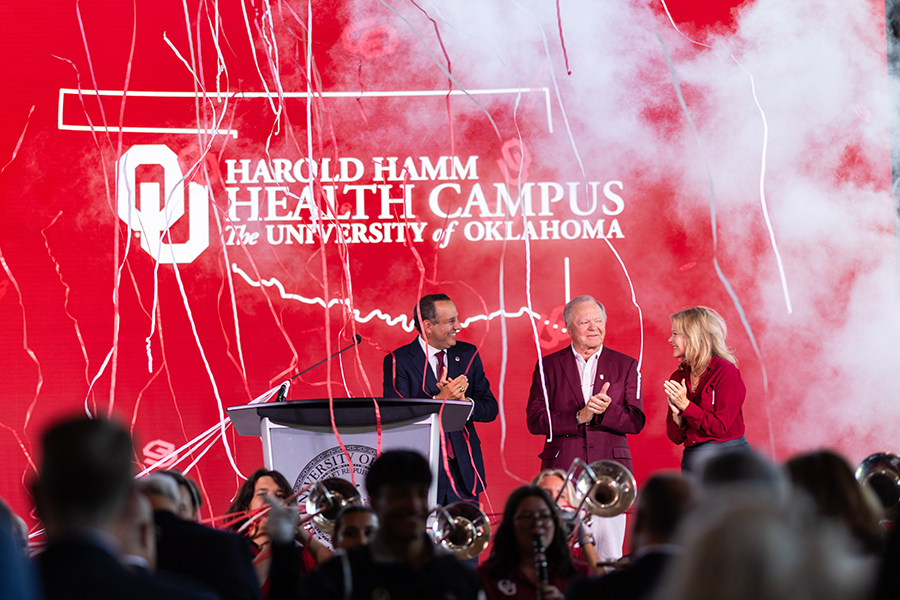
The University of Oklahoma today announced an historic $150 million gift from Harold Hamm, the largest single gift in university history, to lift the health of Oklahoma by advancing health education, research and discovery, strengthening the state’s health care workforce and accelerating the pursuit of breakthroughs against Oklahoma’s critical public health challenges.
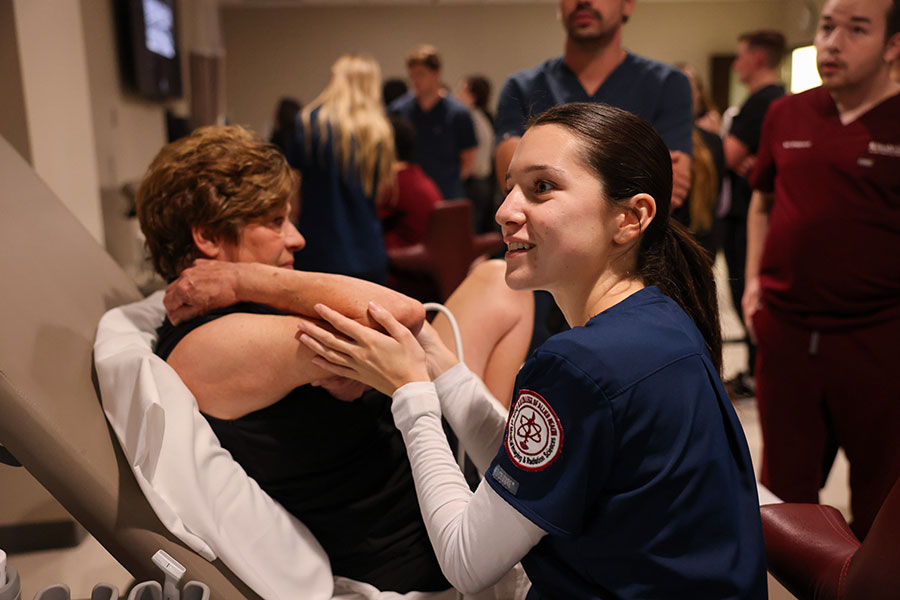
Experienced sonography students in the OU College of Allied Health work with students in the OU College of Medicine on how to utilize modern ultrasound systems. This interprofessional setting is made possible through a recently opened laboratory and cross-college collaboration on the OU Health Campus.
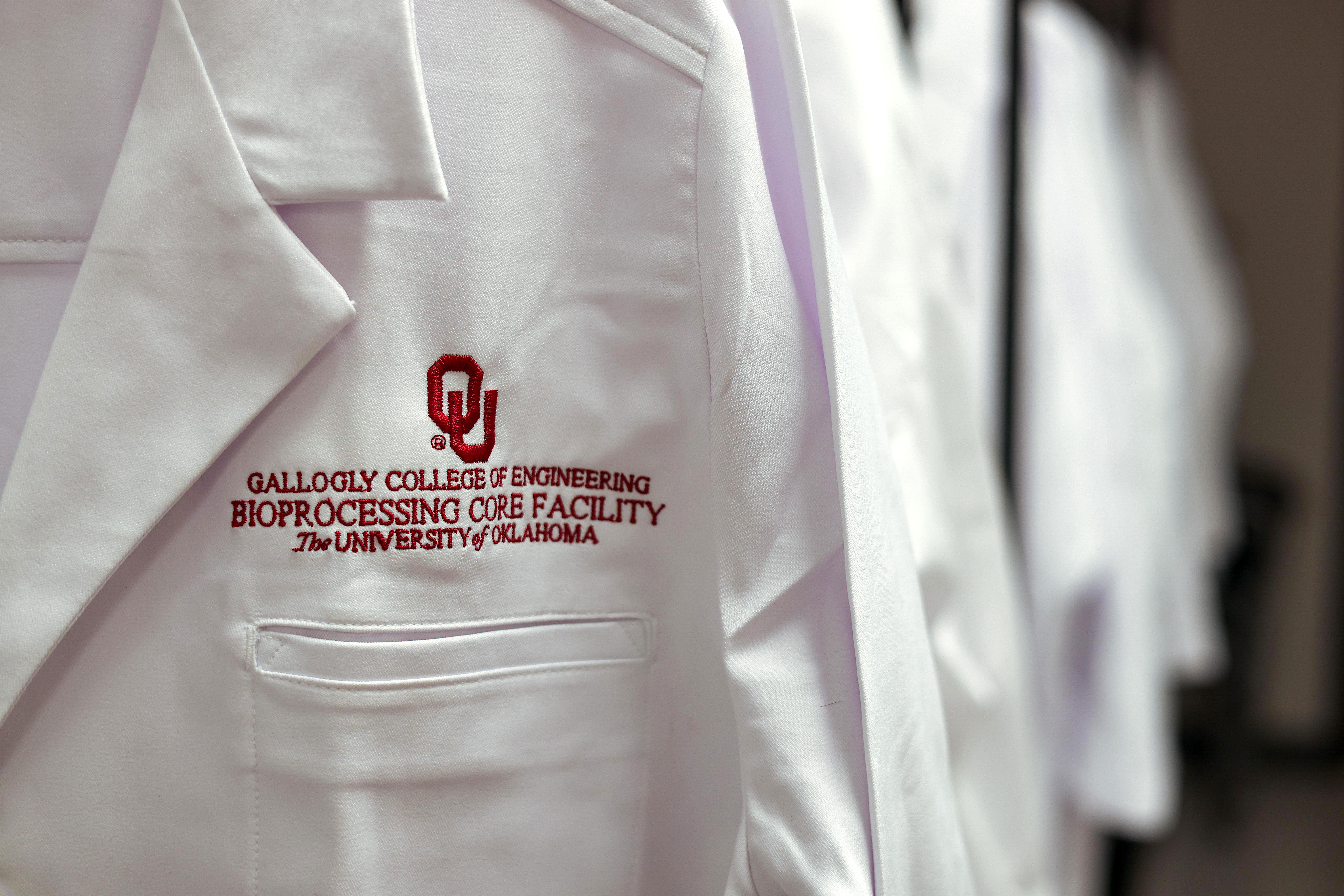
The Gallogly College of Engineering at the University of Oklahoma has launched a new Online Graduate Certificate in Bioprocessing, a forward thinking program designed to expand access to bioprocessing education while strengthening the nation’s biotechnology workforce.