NEWS


For Steven Cavallo, a professor in the School of Meteorology at the University of Oklahoma, the winter storm of January 2026 was one that, quite literally, got away.
Days before thick layers of ice and snow blanketed the Southern United States from Texas to Virginia on January 24-25, Cavallo was high above Canada’s Hudson Bay, collecting data in a NASA storm hunter.
Winter weather was his prey.
“We were tracking the system for days before it hit,” Cavallo said. But in a flash, it disappeared. The limited range of their aircraft, a Gulfstream III, meant tracking the storm more than a few hours was impossible, leaving forecasters to guess where the storm might pack the biggest punch.
It was a missed opportunity that Cavallo and colleagues are working hard to never repeat.
Armed with a four-year, million-dollar grant from NASA, Cavallo is leading a global study of how small disturbances in the polar tropopause, a region roughly 30,000 feet above Earth’s surface, eventually grow into massive winter storms impacting millions.
The program, the North American Upstream Feature-Resolving and Tropopause Uncertainty Reconnaissance Experiment, known as NURTURE, combines atmospheric data from aircraft and weather balloons with additional measurements from international partners in Europe and beyond.
“We’re like hurricane hunters, but we go after winter weather,” Cavallo said. “We are trying to improve our forecasting of big snow events and cold air outbreaks.”
The work is in its early stages. The current NASA grant provides four years of funding to collect data, with several additional years expected for analysis.
But Cavallo believes the payoff could be enormous. While hurricanes and tornadoes have been studied for decades, winter storms have historically received fewer research resources.
“We want to understand these storms, what makes them form and tick, so we can give people more time to prepare,” he said. Failure to do so can cost billions. By one estimate, the January storm took a $115-billion-bite out of the U.S. economy.
One target for Cavallo is a feature called tropopause polar vortices, or TPVs – deep depressions of circulating cold air that form in the high-latitude Arctic. As TPVs develop over weeks or months, they can interact with other atmospheric features before being pulled south by the jet stream, triggering winter weather events in the continental U.S.
“When they first start, they don’t look like much,” Cavallo said. From a pilot’s perspective, the skies can appear clear even as a powerful atmospheric process unfolds beyond the cockpit.
To find the center of these invisible systems, mission scientists rely on a mix of short-range weather forecasts and real-time data collected during flights. Cavallo himself often serves as a mission scientist on board, helping guide the aircraft’s path as conditions evolve.

When these features become visible, winter weather is almost certain, Cavallo said. “That's the value that we're adding. We need instruments to tell us what the atmosphere is doing in these situations. Once you can see it, a storm is likely a few days away. That’s not a huge lead time for people to prepare.”
The January 2026 storm was one such system. Cavallo and his team observed it forming far to the north before it began its southward march. Like a low-flying satellite, NASA’s Gulfstream III zigzagged through the vortices, sucking up data on moisture, temperature and wind. But with a range of just six hours, their plane’s ability to track it was limited.
"We generally can observe these storms forming, but when they start moving south, we can't reach them anymore,” he said.
The limitation has long left scientists with gaps in their observations – precisely when storms begin intensifying and threatening populated regions.
That will change starting next year, when NASA inaugurates its new Boeing 777 airborne science laboratory. With a flight time more than triple that of the Gulfstream III, Cavallo and his NURTURE colleagues will be able to follow storms farther from their source.
The new aircraft will also carry more scientific instruments, dramatically expanding the amount of atmospheric data researchers can collect. Compared to the current plane, which carries only a handful of instruments, the 777 will have 17.
“We'll have a lot more information about moisture, and much more information on wind – a data point that was lacking this year,” Cavallo said.
Those measurements are important in the upper troposphere and lower stratosphere, a region of mixing where moisture and temperature are difficult to gauge. Satellite observations in this region can be limited, making airborne data collection critical. For instance, understanding how moisture moves vertically through the atmosphere near TPVs and the polar jet stream is a key question scientists hope to answer.
Ultimately, more data will help improve the precision and capabilities of weather models, Cavallo said, leading to earlier and more accurate winter storm forecasts.
Achieving that goal has been a lifelong endeavor for Cavallo. Growing up near Atlanta, one of the first storms he remembers vividly was the Blizzard of 1993. The Storm of the Century, which formed over the Gulf of Mexico on March 12 that year, killed several hundred and knocked out power to more than 10 million households.
“At the time, I was amazed that forecasters could predict the storm five days in advance,” Cavallo recalled.
But more than 30 years later, youthful amazement has morphed into professional challenge. Five days remains about the outer limit for reliable winter weather predictions. “We need to extend that timeline,” he said.

About the project
The project, “Observing the formation and development of tropopause polar vortices to enhance understanding of the dynamics and predictability of downstream high-impact weather systems,” is funded by NASA Award No. 80NSSC24K1760.
About the University of Oklahoma
Founded in 1890, the University of Oklahoma is a public research university located in Norman, Oklahoma. As the state’s flagship university, OU serves the educational, cultural, economic and health care needs of the state, region and nation. For more information about the university, visit www.ou.edu.
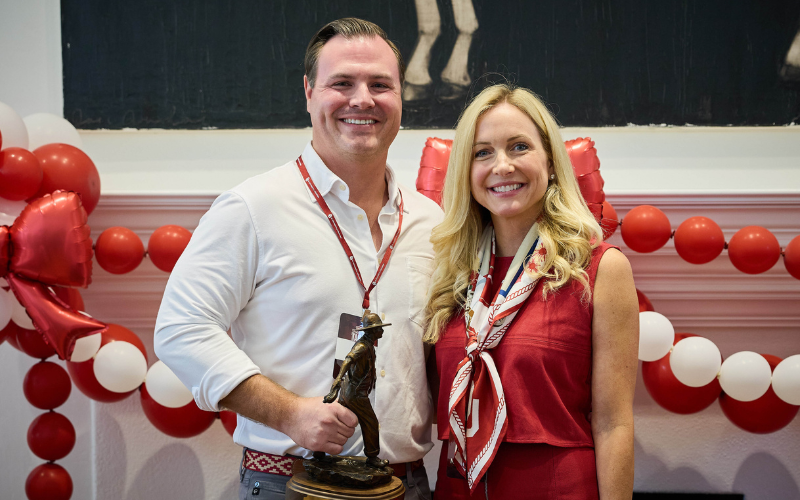
The University of Oklahoma has received a transformative gift from Jon and Shannon McCartney, which will name the McCartney Family Tunnel of Champions, the McCartney Family Gate of the Gaylord Family - Oklahoma Memorial Stadium and the McCartney Family Grand Lecture Hall in the Michael F. Price College of Business. The gift will also support the Inspiring Champions and the Athletic Director’s Discretionary Fund, in addition to establishing the McCartney DFW Career Trek program at Price College.
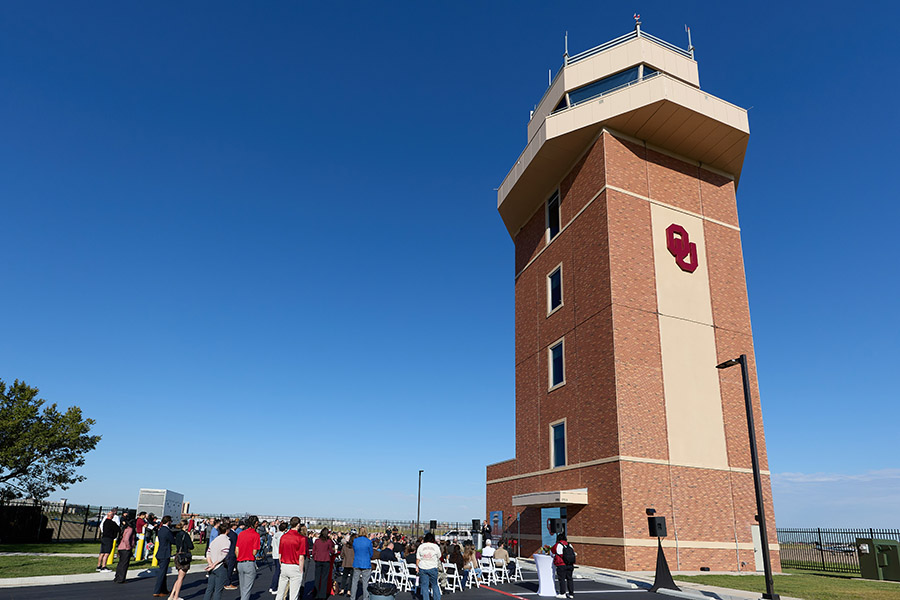
The University of Oklahoma today celebrated the opening of a new air traffic control tower at the OU Max Westheimer Airport. Standing 106 feet tall, more than double the current 52-foot facility, the new tower will modernize air traffic control operations and improve safety for pilots and students operating in the airspace.
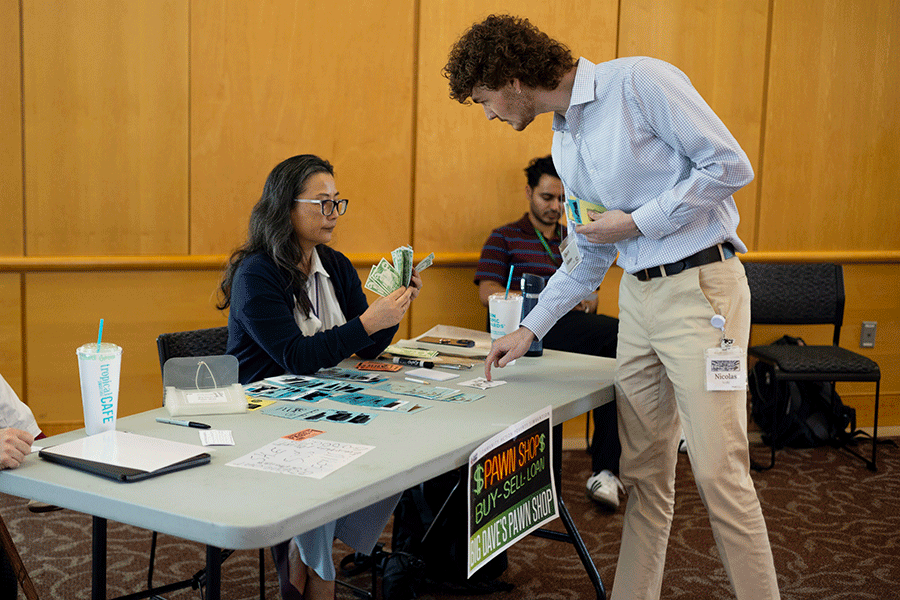
Do I buy groceries or pay the electric bill? Should I pawn some of my belongings to afford my prescription? My child is sick, so I will have to miss work to take care of him. Those are just a few of the difficult choices that OU-Tulsa health professional students confronted during the Community Access to Resources Experience. The role-playing activity challenged students to navigate the financial, family and other pressures that can affect a person’s health and ability to follow medical advice. Held annually during the SCM Institute orientation week, the experience is designed to generate understanding and build empathy.