NEWS


NORMAN, Okla. — Soil is one of Earth’s largest carbon storages, holding more than three times the carbon found in the atmosphere. Understanding what controls whether soils gain or lose carbon has broad implications for the carbon cycle and beyond. A 12-year field experiment at the University of Oklahoma has revealed that warming's effect on soil carbon storage depends critically on precipitation.
The findings, published in Nature Climate Change, help explain why decades of research on this question have produced conflicting results and point to soil microbes as the key mechanism driving the observed differences.
Researchers found that warming-induced soil carbon loss is moderated by precipitation. The greatest amount of carbon loss occurred under drought, not under wet conditions. Warming reduced soil carbon by 12.2% under drought conditions but increased it by 6.7% under wet conditions. The study is among the longest continuous field experiments of its kind, filling an important gap: most previous research has relied on experiments lasting fewer than five years, which the authors argue is insufficient given how slowly soil carbon cycles.
Jizhong Zhou, director of the Institute for Environmental Genomics and George Lynn Cross Research professor in the School of Biological Sciences, points to the design of previous studies as a key reason for the contradictions in existing literature.
“This discrepancy likely arises because most studies rely on snapshot data from relatively short experiments, ignoring the long-term temporal dynamics of soil carbon under warming, particularly in conjunction with co-occurring changing factors like drought, wet conditions, and land-use change,” said Zhou.
Carbon losses under drought were driven primarily by the breakdown of mineral-associated organic carbon — a form long considered stable and resistant to decomposition. The team found that warming accelerated microbial metabolic activity under drought, causing microbes to consume carbon at higher rates, while suppressing that same activity under wet conditions. These shifts corresponded with changes in microbial community composition and the prevalence of carbon-degrading genes. The shifts appear to be the primary mechanisms by which warming and precipitation interact to drive changes in soil carbon.
When the researchers incorporated these microbial dynamics into an ecosystem model, their predictions of soil carbon changes improved substantially, suggesting that models that exclude microbial processes may produce inaccurate projections.
About the Research
“Drought amplifies warming-induced soil carbon loss in a decade-long experiment” is published in Nature Climate Change at doi.org/10.1038/s41558-026-02584-2.
About the University of Oklahoma
Founded in 1890, the University of Oklahoma is a public research university located in Norman, Oklahoma. As the state’s flagship university, OU serves the educational, cultural, economic and health care needs of the state, region and nation. For more information about the university, visit www.ou.edu.
The University of Oklahoma has received a transformative gift from Jon and Shannon McCartney, which will name the McCartney Family Tunnel of Champions, the McCartney Family Gate of the Gaylord Family - Oklahoma Memorial Stadium and the McCartney Family Grand Lecture Hall in the Michael F. Price College of Business. The gift will also support the Inspiring Champions and the Athletic Director’s Discretionary Fund, in addition to establishing the McCartney DFW Career Trek program at Price College.
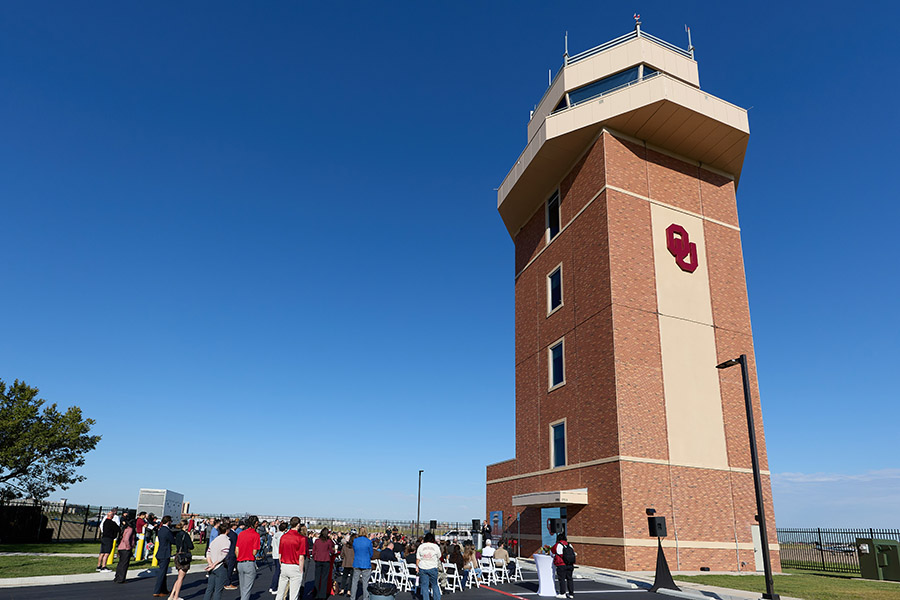
The University of Oklahoma today celebrated the opening of a new air traffic control tower at the OU Max Westheimer Airport. Standing 106 feet tall, more than double the current 52-foot facility, the new tower will modernize air traffic control operations and improve safety for pilots and students operating in the airspace.
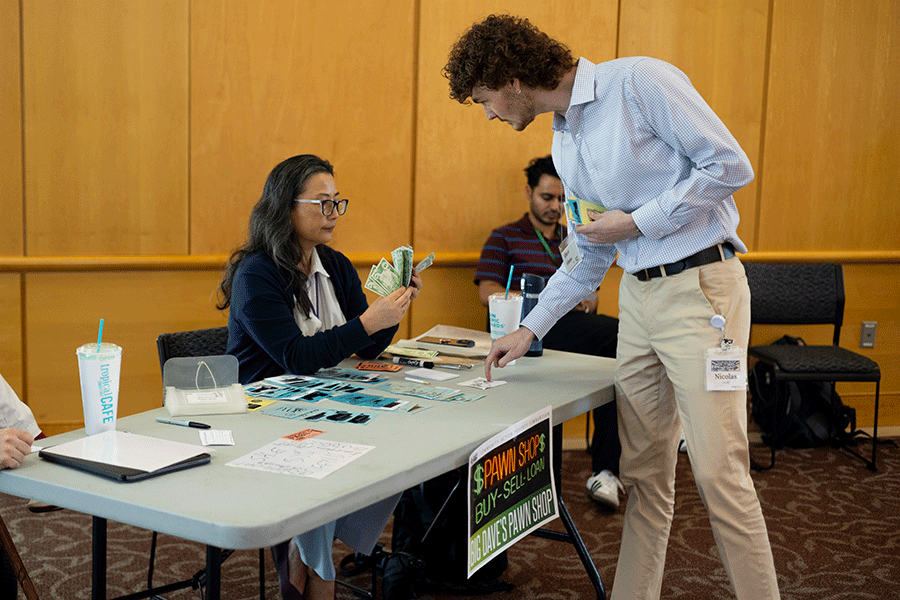
Do I buy groceries or pay the electric bill? Should I pawn some of my belongings to afford my prescription? My child is sick, so I will have to miss work to take care of him. Those are just a few of the difficult choices that OU-Tulsa health professional students confronted during the Community Access to Resources Experience. The role-playing activity challenged students to navigate the financial, family and other pressures that can affect a person’s health and ability to follow medical advice. Held annually during the SCM Institute orientation week, the experience is designed to generate understanding and build empathy.