Pueblo Bonito, Chaco Canyon, New Mexico (left) and Ganjali Khan Complex, Kerman. Iran (right) — two desert complexes responding to similar climatic challenges through opposite strategies, yet united by common architectural organizing principles. Left: Public domain, NPS, 1984. Right: Drawing by Khosrow Bozorgi.
Dr. Khosrow Bozorgi, professor of Architecture at the Christopher C. Gibbs College of Architecture at the University of Oklahoma, is advancing a major research project that examines how societies across time and place have organized the built environment in strikingly similar ways.
Dr. Bozorgi’s work draws on fieldwork conducted across five cultural contexts—ancient Roman Tunisia, medieval Morocco, Safavid Iran, Hanseatic Germany, and pre-Columbian New Mexico. Across these cases, he has found that settlements consistently organize space in three parts: an outward-facing public realm, a semi-private transitional zone, and a protected interior domain.
His project frames this pattern as a form of convergent architectural evolution. Independent cultures, working without shared contact or precedent, have arrived at comparable spatial solutions to address common human concerns, including climate, social interaction, and privacy.

House of the Hunt, Bulla Regia, Tunisia (2nd–4th century CE). The underground peristyle courtyard and site plan demonstrate that classical architectural principles and spatial hierarchy transcend specific environmental responses. Left photo: Khosrow Bozorgi, May 2022; Right plan: Public domain.
Dr. Bozorgi’s research integrates original measured drawings, site documentation, and longitudinal analysis across these regions, and comparative analysis is central to Dr. Bozorgi’s project. At Pueblo Bonito in Chaco Canyon, ancestral Puebloan builders used massing and orientation to manage extreme desert conditions. At the Ganjali Khan Complex in Kerman, Iran, a dense network of passages and wind towers facilitates air movement and cooling. While the technologies and environmental strategies differ, both environments reflect the same underlying spatial sequence from public to private space
Dr. Bozorgi’s findings will be presented in his forthcoming book, The Grammar of Space: Architectural Patterns Across Time and Culture, which is currently under contract with Birkhäuser, with publication expected in 2027.
Construction Industry Speaker Series welcomed Stephen Evans from the Oklahoma City National Memorial & Museum to give a lecture on better conversations and relationship building.
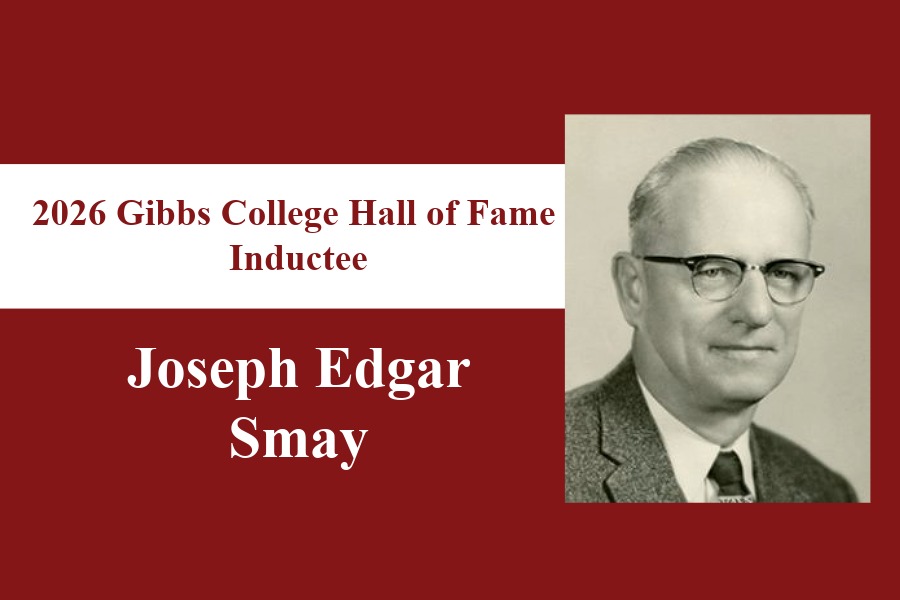
The University of Oklahoma Christopher C. Gibbs College of Architecture Hall of Fame recognizes a select number of high-character individuals who have made a significant and lasting positive impact on Gibbs College, its students, staff, faculty, alumni and/or to communities across the globe. The impact may have been, or continues to be, in the form of service and mentorship, sustained professional excellence, and/or advancement and financial support. Joseph Edgar Smay is part of the 2025 Hall of Fame class.
Christopher C. Gibbs College of Architecture congratulates three architecture students who were recognized in the 2026 AIA Dallas Student Design Awards.