NEWS


NORMAN, OKLA. – With roughly one-quarter of the University of Oklahoma’s research rooted in AI, OU is harnessing its transformative power across fields to drive real-world solutions and equip students to thrive as professionals and citizens amid rapid technological change. To expand AI-driven innovation at the university and further a commitment to providing students with a leading AI education, OU has named Shishir Shah, Ph.D., as the first university-wide Chief Artificial Intelligence Officer, pending OU Regents’ approval.
“The University of Oklahoma is at the forefront of harnessing artificial intelligence to solve complex problems and drive meaningful change,” said OU President Joseph Harroz Jr. “Through pioneering research and cross-disciplinary collaboration, we are transforming AI’s potential into powerful solutions that address critical global challenges. Dr. Shah’s appointment signals a bold step forward in strengthening this commitment and accelerating our leadership in the field.”
Shah’s arrival comes at a defining moment for the university, as OU deepens its focus on AI as a key priority of the “Lead On, University: The Next Phase” Strategic Plan. By advancing university-wide strategy in AI innovation, research, education and implementation, Shah will lead a charge to reimagine curriculum and academic opportunities to integrate AI across the student educational experience, guaranteeing that OU graduates enter the workforce as literate and responsible AI-users able to leverage the technology for maximum impact.
OU’s Data Institute for Societal Challenges, which develops convergent research teams to make advances in data science, AI and machine learning, recently announced the award of nearly $200,000 in pilot seed funding to 20 AI-focused projects touching on topics from legal education to clinical imaging reports.
This new wave of activity builds on OU’s existing commitment to AI-enabled research. In health fields, university researchers are using AI to develop novel endoscopic optical imaging techniques, advance cardiac arrhythmia research and make genetic discoveries that could lead to future breakthroughs for personalized medicine. AI powers OU’s next-generation weather research, including pioneering all-digital polarimetric phased array radar. Student researchers are also deploying AI, including seniors in the School of Meteorology who dedicated their senior capstone work to researching explainable artificial intelligence and the formation of tornadoes, tackling the problem of severe weather that impacts Oklahomans every year.
Under Shah’s leadership, OU is poised to strengthen its role at the forefront of ethical and transformative uses of AI, expanding its global impact and capacity to address society’s most complex challenges.
Shah’s research expertise concentrates on computer vision and machine learning, and he is an expert in person re-identification, human motion and behavior analysis, and microscope image analysis. His recent work addresses real-world AI challenges, pushing the boundaries of adaptive, intelligent systems in complex environments.
Shah comes to OU from the University of Houston, where he served as Professor and Chair of the Department of Computer Science. He founded and led UH’s Quantitative Imaging Laboratory, which focuses on developing advanced image and video analysis tools that support complex decision making. He earned a B.S. in mechanical engineering, M.S. and Ph.D. in electrical and computer engineering from the University of Texas at Austin. Prior to joining the University of Houston in 2005, he served as a faculty member at Wayne State University before transitioning to leadership roles in two startup companies.
In addition to this appointment, Shah will join the Gallogly College of Engineering as Director of the School of Computer Science. He will report jointly to the Senior Vice President and Provost of both the OU Norman and OU Health Sciences campuses.
About the University of Oklahoma
Founded in 1890, the University of Oklahoma is a public research university located in Norman, Oklahoma. As the state’s flagship university, OU serves the educational, cultural, economic and health care needs of the state, region and nation. For more information about the university, visit www.ou.edu.
The University of Oklahoma has received a transformative gift from Jon and Shannon McCartney, which will name the McCartney Family Tunnel of Champions, the McCartney Family Gate of the Gaylord Family - Oklahoma Memorial Stadium and the McCartney Family Grand Lecture Hall in the Michael F. Price College of Business. The gift will also support the Inspiring Champions and the Athletic Director’s Discretionary Fund, in addition to establishing the McCartney DFW Career Trek program at Price College.
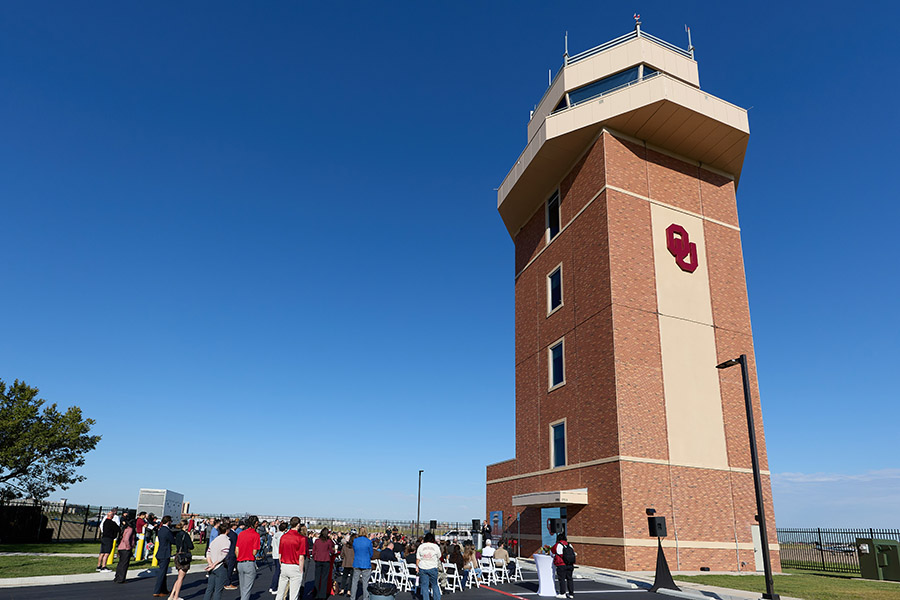
The University of Oklahoma today celebrated the opening of a new air traffic control tower at the OU Max Westheimer Airport. Standing 106 feet tall, more than double the current 52-foot facility, the new tower will modernize air traffic control operations and improve safety for pilots and students operating in the airspace.
Do I buy groceries or pay the electric bill? Should I pawn some of my belongings to afford my prescription? My child is sick, so I will have to miss work to take care of him. Those are just a few of the difficult choices that OU-Tulsa health professional students confronted during the Community Access to Resources Experience. The role-playing activity challenged students to navigate the financial, family and other pressures that can affect a person’s health and ability to follow medical advice. Held annually during the SCM Institute orientation week, the experience is designed to generate understanding and build empathy.