NEWS


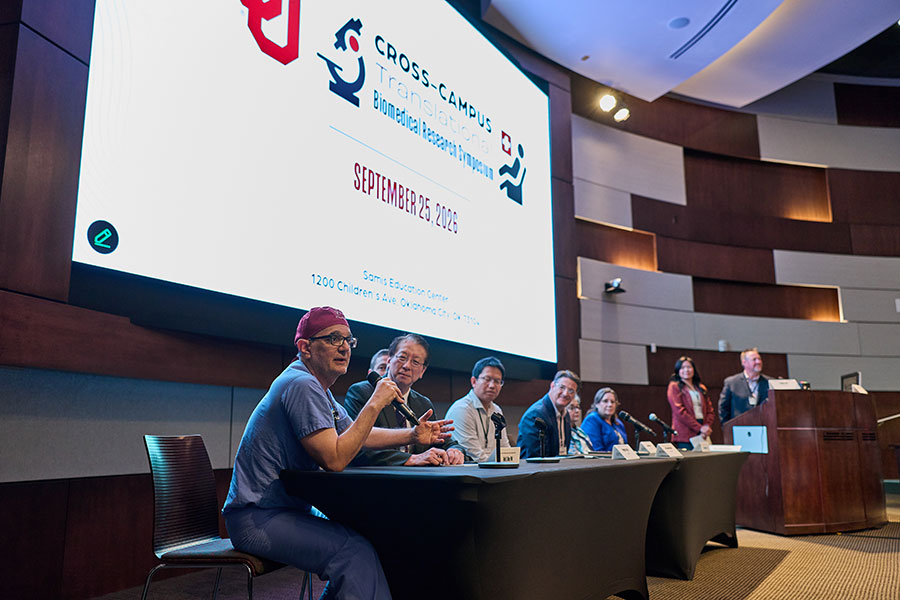
NORMAN, Okla. – More than 250 researchers, clinicians, engineers, entrepreneurs and students gathered Sept. 25 for the University of Oklahoma’s first Cross-Campus Translational Biomedical Research Symposium. The daylong event was designed to strengthen collaboration across OU’s campuses and speed the path from laboratory discovery to patient care.
“This symposium was not only an exciting cross-campus event bringing together participants from OU Norman, Health, and Tulsa campuses, but also a statewide gathering involving Oklahoma State University, OMRF, ARL Bio Pharma, Novartis, OKBioStart, and many other Oklahoma institutions and organizations,” said Wei Chen, Stephenson Endowed Chair, Professor, and Director of the Stephenson School of Biomedical Engineering from Norman Campus. “It brought together established researchers and practitioners alongside emerging scholars, from junior faculty and postdoctoral fellows to graduate students, medical trainees, undergraduate students, and high school students. Through oral and poster presentations, roundtable discussions, learning activities, and workshops, participants exchanged ideas, built new collaborations, and strengthened their commitment to translational research, entrepreneurship, and commercialization. Next year, we expect to move this symposium to a new level.”
Chen co-chaired the event with Doris Mangiaracina Benbrook, Ph.D., associate director of translational research at the Stephenson Cancer Center at the OU Harold Hamm Health Campus and Presbyterian Presidential Professor of obstetrics and gynecology in the College of Medicine. Both co-chairs have moved their own discoveries into the clinic. Benbrook led teams that took the investigational cancer drug SHetA2 from concept to a Phase 1 clinical trial entirely within an academic setting, and the drug is now advancing to a National Cancer Institute-funded Phase 2 trial. Chen co-founded Immunophotonics Inc., which received U.S. Food and Drug Administration approval in 2023 for a multicenter clinical trial of the localized cancer immunotherapy his team developed.
“We were delighted to have such a tremendous turnout of attendees from all OU Campuses and trainees ranging from high school students to junior faculty,” said Benbrook. “This symposium represented a fertile basis for cultivating multi-disciplinary translation of discoveries to clinical trials and on to improving the health of Oklahomans. We hope to continue and expand upon this inaugural event to foster translation and academic entrepreneurship.”

The program opened with remarks from university leaders. Among them was Lara Ferry, Ph.D., OU’s first vice president and chief research innovation officer, who leads the university’s efforts to move discoveries more quickly into real-world use.
During the morning, OU faculty founders and innovators shared how they have carried research beyond the lab. Their work spanned new treatments for drug-resistant infections, health data infrastructure, organ imaging and preservation, surgical extended reality and medical technology for battlefield and disaster settings. Speakers also explored how behavioral science can help shorten the years-long gap between scientific discovery and routine clinical practice.
The afternoon turned to the practical side of translation. Panels and workshops brought together faculty entrepreneurs, investors, industry leaders and regulatory experts. They discussed commercialization, intellectual property, FDA pathways for drugs and medical devices, clinical trials and cross-disciplinary collaboration. Attendees also met one-on-one with OU and statewide innovation resources, practiced pitching their research and connected with experts and potential collaborators during a networking session.
The day also included a presentation competition. Winners included:
Oral presentations
Junior faculty
Postdoctoral fellows
Poster presentations
Junior faculty
Graduate and medical students
Postdoctoral fellows
High school and undergraduate students
About the University of Oklahoma
Founded in 1890, the University of Oklahoma is a public research university located in Norman, Oklahoma. As the state’s flagship university, OU serves the educational, cultural, economic and healthcare needs of the state, region and nation. For more information about the university, visit www.ou.edu.
More than 250 researchers, clinicians, engineers, entrepreneurs and students gathered Sept. 25 for the University of Oklahoma’s first Cross-Campus Translational Biomedical Research Symposium.
State agencies across the United States rely on irrigation maps for managing freshwater resources. Researchers from the University of Oklahoma are improving these critical maps by leading two projects that will support timely, reliable information.
A first-of-its-kind study from the University of Oklahoma found that hospice agencies can provide blood and platelet transfusions at home for patients with blood cancers who are no longer pursuing aggressive treatment. The approach allowed patients to receive transfusions for symptom relief without repeated trips to a hospital or clinic, giving them more opportunity to spend time with loved ones.