NEWS


By
Jacob Muñoz
jmunoz@ou.edu
Date
NORMAN, Okla. – Could simple design choices affect how an app’s users spend their own money? According to research from Yaron Levi, Ph.D., an associate professor of finance in the University of Oklahoma’s Price College of Business, those choices can have a major impact on their financial decisions for months on end.
Levi’s recent study published in the Journal of Financial and Quantitative Analysis examines how users interact with an online account aggregation app. This software allows users to view their transactions and balances across checking, savings, retirement and other accounts, providing them an efficient way to monitor their finances.
Levi’s research explored how changes to the app’s dashboard affected thousands of users’ financial management over the span of 20 months. The real-world study was made possible with support from the financial startup company that created the app, a productive outcome of industry-academia collaboration.
As a researcher interested in human decision-making, Levi’s study is part of a larger body of work aimed at uncovering how and why people make financial choices.
“The average person doesn't know a lot of finance,” Levi said. “Humans typically learn by trial and error. But saving for retirement is something that you get to do once in your life. And if you get it wrong, the consequences are severe.”
The app’s users all had online dashboards that displayed their net worth, total income and total spending. For the study, users were randomly assigned to different versions of the dashboard.
Four of the five groups received a personalized index of their net worth shown as a lifetime monthly cash flow, rather than simply a lump sum of money. This presented finances in a much more familiar way for the average person, who may budget month to month.
Two of those four groups also had their index labeled as a “financial sustainability index,” with a message framing their spending and payment habits as affecting cash flow. They also received a context plot comparing the index level to their own historical monthly spending.
According to Levi, this strategy of emphasizing financial consumption over financial investment has been discussed in economics literature as a way to influence behavior.
“It operates a bit on a fear mechanism,” he said. “Because if this is my financial sustainability index and I spend much more than this, it means that my spending behavior is not sustainable and I'm about to run out of money. So that drives people to pay attention to this index.”
The study found that the two groups with the financial sustainability index reduced their spending over the course of the experiment compared to the months right before it began. The results demonstrate the power of framing and context on consumer behavior.
Levi said he hopes the study can provide regulators more information on how to oversee companies that provide financial services. Businesses like loan providers and wealth management groups already use techniques similar to the fear framing that his study examined, he said, and regulators may want to determine guidelines for presenting financial information to clients.
He also emphasized that everyone could benefit from thinking about how their actions are influenced by various factors, many of which are taken for granted.
“The way that information is presented to you is not random,” Levi said. “Someone designed it in an attempt to shape your behavior one way or another. Just being aware of that makes you reflect on, ‘Am I doing the right thing?’ and ‘How did I come to behave the way I behave?’ Doubt and curiosity can benefit everyone.”
About the research
The study, “Personal Financial Information Presentation and Consumer Spending,” can be found in the Journal of Financial and Quantitative Analysis at https://doi.org/10.1017/S0022109026102749.
About the University of Oklahoma
Founded in 1890, the University of Oklahoma is a public research university located in Norman, Oklahoma. As the state’s flagship university, OU serves the educational, cultural, economic and healthcare needs of the state, region and nation. For more information about the university, visit www.ou.edu.
Price College of Business associate professor Yaron Levi, Ph.D., has explored how changes to an app's dashboard affected thousands of users’ financial management over nearly two years.
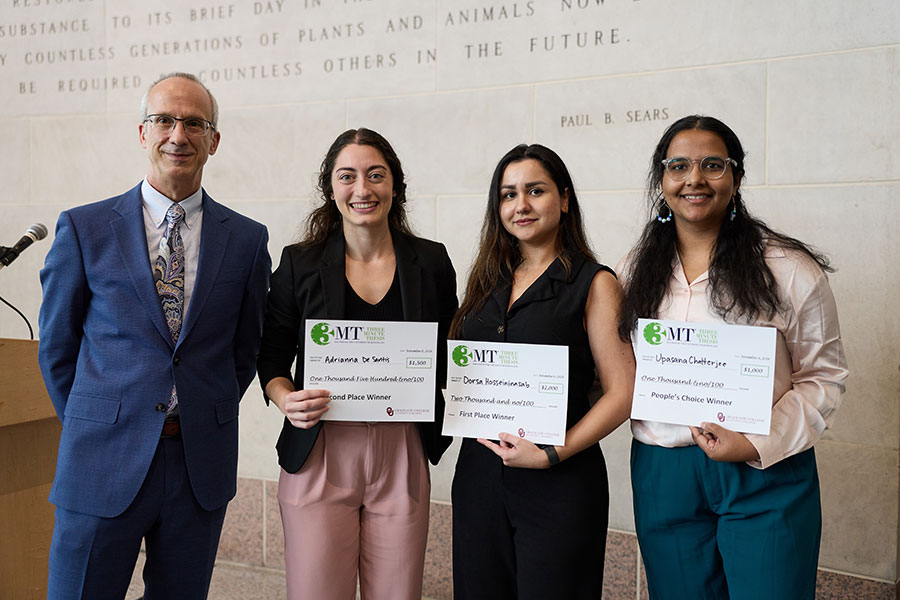
Three University of Oklahoma graduate students earned top honors in the 2026 Three Minute Thesis (3MT) competition, an annual event that challenges students to explain their research to a general audience in 3 minutes.
Researchers at the OU Health Harold Hamm Diabetes Center are investigating diabetes from numerous angles, including how the disease affects other organs, what factors contribute to its development and complications, and how new approaches to prevention and treatment could improve health.