NEWS


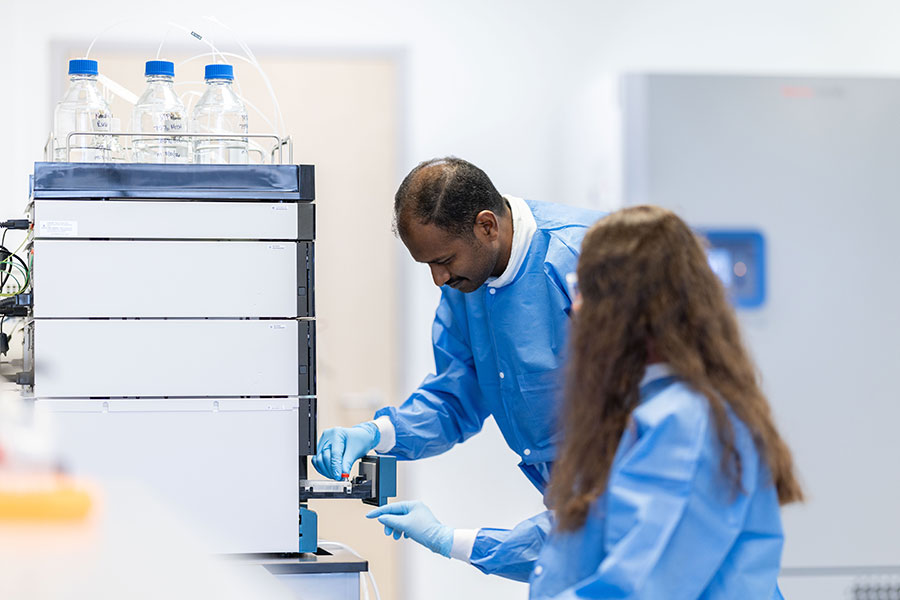
OKLAHOMA CITY – Researchers on the Harold Hamm Health Campus at the University of Oklahoma have gained a critical tool for studying medical drugs thanks to ongoing support from the Presbyterian Health Foundation (PHF). The Oklahoma City-based nonprofit provided a grant for OU’s College of Pharmacy to obtain its first liquid chromatography mass spectrometry (LC-MS/MS) equipment system, expanding the health campus’s ability to turn research into real-world impact.
Within pharmacokinetics, the study of how a body affects a drug, LC-MS/MS instruments are the gold-standard approach to identifying how much of a drug is in the bloodstream or other body fluids and organs. They do this by first separating chemicals from body samples, such as human plasma, then breaking them down into smaller parts that the system measures. These measurements provide valuable data for interpreting and predicting drug outcomes.
The newly acquired instrument is hosted at the College of Pharmacy’s Analytical and Translational Pharmacology (ATP) Laboratory. Mackenzie Cottrell, Pharm.D., M.S., heads the lab and serves as the college’s Director of Drug Development.
“In the ATP lab, we measure drug concentrations, then use computer-based approaches along with cell culture systems to predict what drug doses are needed to get the desired effects,” said Cottrell, who is also an associate professor in the College of Pharmacy. “We want to be within a therapeutic window where there’s enough drug to get the response that we want, but not too much that we get an adverse response.”
Cottrell noted that while the new LC-MS/MS instrument is not the first of its kind on the health campus, its arrival at the College of Pharmacy will uniquely pair this technology with pharmacokinetic expertise. This pairing will support the development of predictive models to anticipate a population’s response to a drug dosing strategy as well as how special populations – such as pregnant women, children or people with organ damage – would be expected to respond.
The ATP Laboratory aims to make the instrument and expertise available to investigators across the health campus who are seeking support in designing and performing pharmacokinetic assessments, thereby increasing opportunities for interdisciplinary collaboration.
“Say there's somebody investigating a new drug molecule for a cancer treatment, and they're testing the drug in people for the very first time,” Cottrell said. “We would be a great partner for them, in terms of our ability to turn samples collected from a person participating in that clinical trial into pharmacokinetic data to help the investigators understand how the new drug moved throughout the person’s body over time after the drug was taken.”

Vincent Dennis, Pharm.D., Chair for the Department of Pharmacy: Clinical & Administrative Sciences, said that recruiting Cottrell and acquiring the LC-MS/MS technology were strategic to bolster campus research partnerships.
“Support from the Presbyterian Health Foundation was fundamental for Dr. Cottrell’s equipment grant, to complement existing research infrastructure and bridge gaps for collaborative translational and clinical research,” Dennis said.
Since 2014, the Presbyterian Health Foundation has given roughly $45.2 million to support the PHF Research Grant Program, which funds multiple types of grants, including Bridge, Seed and Clinical Scientist Development Grants. These investments have helped OU researchers successfully compete at the national level and develop research programs.
“PHF is proud to support investments like this that give OU researchers the tools to advance discoveries and improve health,” said April Stuart, PHF’s Director of Grants and Programs. “This grant strengthens the College of Pharmacy’s research capabilities and supports studies that deepen our understanding of how medicines work in the body, helping translate scientific discoveries into better patient care.”
“Our longstanding partnership with OU reflects a shared commitment to advancing research that makes a real difference for Oklahomans,” Stuart added. “We are pleased to help provide the resources researchers need to move that work forward.”
Melissa Medina, Ed.D., Dean of the College of Pharmacy, highlighted the importance of these ties.
“Partnerships like this one between the college and PHF are key to helping OU accomplish its strategic plan initiative of lifting the health of Oklahoma,” Medina said. “I am proud of Dr. Cottrell and the college for their work to fulfill this mission that serves patients.”
About the University of Oklahoma
Founded in 1890, the University of Oklahoma is a public research university located in Norman, Oklahoma. As the state’s flagship university, OU serves the educational, cultural, economic and healthcare needs of the state, region and nation. For more information about the university, visit www.ou.edu.
One in eight Oklahomans has type 2 diabetes, and an estimated one-third of the state’s adult population has undiagnosed prediabetes. University of Oklahoma researchers are developing a digital outreach program to help people understand their risk and connect with resources to help prevent the disease.
The Presbyterian Health Foundation has provided a grant for the University of Oklahoma College of Pharmacy to obtain its first liquid chromatography mass spectrometry equipment system. This acquisition expands the health campus’s ability to turn research into real-world impact.
Armed with a new five-year, $3.4 million grant from the National Institutes of Health, OU healthcare leaders are building the first chronic pain mHealth intervention app made with and for Native Americans.