
The National Weather Center (NWC) was officially dedicated on September 29, 2006. More than 1,000 members of the university and national weather and research forecasting communities attended the ceremony.
Since then, the NWC has been in operation 24/7.

The National Weather Center was a joint design venture between Beck Associates Architects and LAN/Daly.

The National Weather Center under construction in 2003.

Construction continued through 2006.

An aerial view as the National Weather Center (upper left) nears completion in early 2006.

The ribbon cutting makes it official! After decades of planning and years of construction, The National Weather Center was officially dedicated on September 29, 2006.

The National Weather Center Dedication ceremony was held in the atrium.
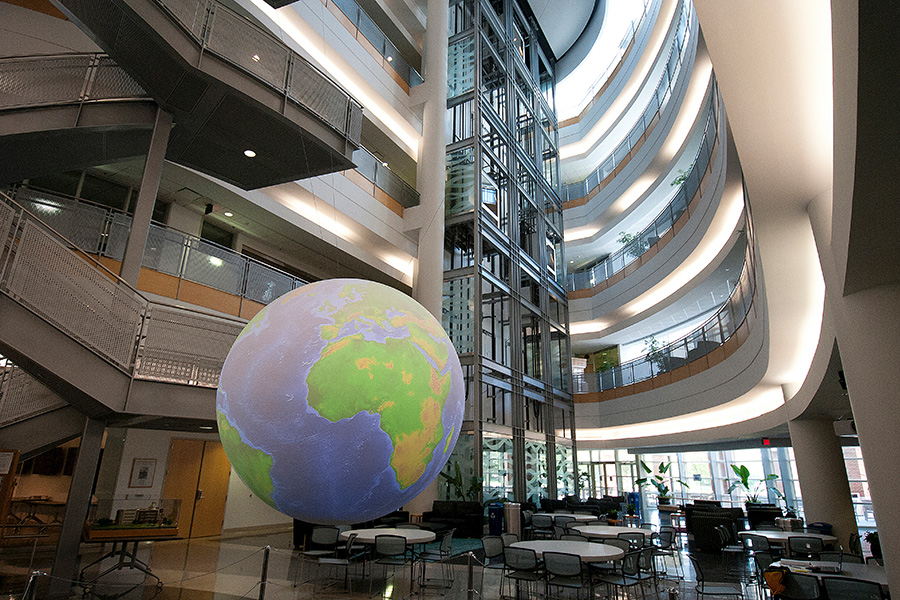
Located in the artium of the National Weather Center, Science On a Sphere® (SOS) is a global display system that uses computers and video projectors to display planetary data onto a six foot diameter sphere, analogous to a giant animated globe. Researchers at NOAA developed Science On a Sphere® as an educational tool to help illustrate Earth System science to people of all ages. Animated images of atmospheric storms, climate change, and ocean temperature can be shown on the sphere, which is used to explain what are sometimes complex environmental processes, in a way that is simultaneously intuitive and captivating.
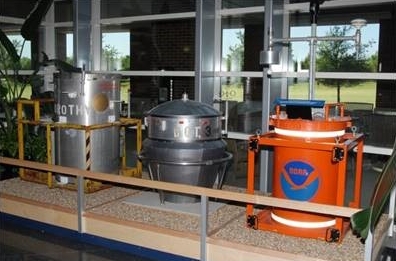
‘Dorothy’ and ‘Toto’, the iconic tornado props from the movie Twister are the building’s biggest stars!

The National Weather Center (NWC) Library began operating in 2006, when the National Severe Storms Laboratory (NSSL) Library was merged with OU's School of Meteorology library. We support the research, education, outreach, and operations of all NWC entities, including the University of Oklahoma College of Atmospheric and Geographic Sciences, federal NOAA partners, and affiliated research and development groups and offer research services to anyone in the general public with an interest in weather or geography.
Our library is also home to unique government documents, historical weather maps, and rare field sketchbooks of tornadoes from the 1800s. As the library is a joint venture of the University of Oklahoma and NOAA, we facilitate access to both educational and federal resources.

NWC 4392A, within the NWC Library, can be reserved for accommodation testing. Course instructors reserving this room for testing will need to provide a proctor, NWC Library staff cannot serve as test proctors. To reserve NWC 4392A, use the reservation form or talk to staff at the NWC Library service desk. If the room is already reserved for the time you need, please contact the library at nwclibrary@ou.edu – priority is given to those needing the space for testing.

NWC 4310, within the NWC Library, can be reserved for group study and meetings with seating for 6. There is a display screen that can be connected to a computer with and HDMI cable or through AirPlay. To reserve NWC 4310, use the reservation form or talk to staff at the NWC Library service desk.


The College of Atmospheric and Geographic Sciences (AGS) offers undergraduate and graduate programs through its three units: the Department of Geography and Environmental Sustainability, the School of Aviation, and the School of Meteorology.
The College's nationally recognized School of Meteorology is housed in the National Weather Center, providing undergraduate and graduate students unique access to the wealth of weather expertise found in the building's research and federal partner institutions.


NOAA’s National Severe Storms Laboratory (NSSL) researches ways to observe and predict severe weather to save lives and reduce economic loss. NSSL scientists and engineers work to understand the causes of severe weather and explore innovative ways to use that knowledge to improve forecasts and warnings. NSSL transfers scientific understanding, applications, and techniques to decision-makers to support a Weather-Ready Nation.

The National Weather Service Norman Forecast Office prepares and disseminates life-saving warnings, watches and advisories for all types of hazardous weather conditions affecting 48 counties in central, western and southern Oklahoma and eight counties in western north Texas. In addition to providing services to protect life and property, the office also produces a wide variety of forecasts, and collects and disseminates climatological and hydrologic data and observations. The office is part of the Southern Region of the National Weather Service. Meteorologists are on duty 24 hours a day, seven days a week.

The Storm Prediction Center provides hazardous weather forecasts including critical tornado and severe thunderstorm watches for the contiguous United States. The SPC also monitors heavy rain, heavy snow and fire weather events across the U.S. and issues specific national products for those hazards. Part of the National Weather Service’s National Centers for Environmental Prediction, SPC meteorologists are on duty 24 hours a day, seven days a week.

The NEXRAD Radar Operations Center provides centralized meteorological, computer software, maintenance, and engineering support for all 158 NEXRAD (WSR-88D) radar systems deployed worldwide. Supported by the Departments of Commerce, Transportation and Defense, the ROC is responsible for modifying and enhancing the WSR-88D systems during their operational life to address changing requirements, technology advances and improved understanding of the application of these systems to real-time weather operations. The ROC also operates and maintains WSR-88D test systems for the development of hardware and software upgrades to enhance system reliability, maintenance, operation and provide new functionality. The facility maintains a 24 hour, seven days a week help desk that assists radar sites with technical support. The ROC also provides or arranges for depot-level maintenance support for field sites. The ROC was established in 1987.

The Warning Decision Training Division develops and delivers training on the integrated elements of the warning process within a National Weather Service forecast office. Part of the National Weather Service Training Division, the WDTD training activities provide basic and advanced WSR-88D operator proficiency, with an emphasis on the integrated data environment, warning methodology and situational awareness. Established in 1989, the WDTD’s goal is to increase expertise among NWS personnel in order to better serve the public in warning situations.


Advanced Radar Research Center (ARRC): The ARRC is involved in many aspects of radar research applied to studies of the atmosphere. Topics range from sophisticated radar signal processing to precipitation microphysical studies.

Center for the Analysis and Prediction of Storms (CAPS): The CAPS mission is to develop and demonstrate techniques for the numerical analysis and prediction of high-impact local weather and environmental conditions, with emphasis on the assimilation of observations from Doppler radars and other advanced in-situ and remote sensing systems.

CSA is a multidisciplinary university research center specializing in the study and application of geospatial science and technology.

CIWRO provides a mechanism that links the scientific and technical resources of OU and NOAA together, to create a center of research for mesoscale meteorology, regional climate studies, and related subject areas.
CIWRO scientists and students conduct research in mesoscale dynamics; radar research, development, and analysis; atmospheric electricity; severe storms; cloud microphysics; and boundary layer studies; with increasing emphasis in recent years on the climatic effects of and controls on mesoscale processes, the socioeconomic impact of such phenomena, and climate change monitoring and detection.
Cooperative Institute for Severe and High-Impact Weather Research and Operations (CIWRO)

Oklahoma Climatological Survey (OCS): OCS was established in 1980 to provide climatological services to the people of Oklahoma, conduct research on the impacts of climate on human activities, and serve as a support facility for the State Climatologist. OCS has a legislative mandate to acquire, process, and disseminate climate and weather data and information for use by the state's citizens.

The Oklahoma Mesonet consists of over 100 automated observing stations that continuously monitor numerous important weather and soil variables. The Oklahoma Mesonet Program is administered jointly by the University of Oklahoma and Oklahoma State University.

The South Central Climate Adaptation Science Center is a partnership between the US Geological Survey and a consortium of seven member institutions consisting of the University of Oklahoma (OU), Texas Tech University (TTU), Louisiana State University (LSU), the Chickasaw Nation (CN), the Choctaw Nation of Oklahoma (CNO), Oklahoma State University (OSU), and the University of New Mexico. The consortium has broad expertise in the physical, biological, natural, and social sciences to address impacts of climate change on land, water, fish and wildlife, ocean, coastal, and cultural resources.

The Southern Climate Impacts Planning Program (SCIPP), a NOAA Climate Adaptation Partnerships team, assists organizations with decision making that builds resilience by collaboratively producing research, tools, and knowledge that reduce weather and climate risks and impacts across the South-Central United States.
