
Production from large oil fields is many times halted when extraction became uneconomic, even though a significant 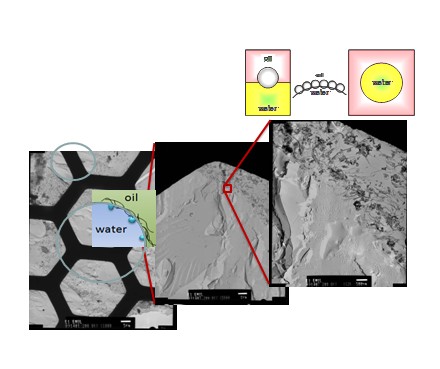 fraction of the original oil in place (OOIP) had not yet been recovered [1]. Development of alternative techniques to economically recover higher amounts of oil is an important goal for engineers and researchers working in the oil industry.
Crude oils have different compositions according several factors such as their geographic location, the type of reservoir that contains them and others. This composition also varies with time due to natural processes which occur in the reservoir [2]. Typically, many kinds of organic molecules (hydrocarbons, aromatics, naphthenes) integrate
petroleum. The target molecule chosen for this study is tetralin (1, 2, 3, 4 tetrahydronapthalene) since many species with similar chemical structure are abundant in crude oils located in different parts of the world.
The overall idea of this project is to partially oxidize non polar compounds contained in the oil in order to decrease the oil – water interfacial tension (IFT) and improve the Capillary Number (Nc). To achieve this, oil – water Pickering emulsions are formed with amphiphilic nanohybrids that will serve not only as surfactants, but also as catalyst for
the partial oxidation. The use of an emulsion system for this process incorporates other benefits such as further decrement of the oil – water IFT by emulsification and enhancement of the MR due to the improved sweeping efficiency by incrementing the sweeping fluid’s viscosity (this happens because the viscosity of the emulsion phase is
greater than both single phases and also because oxidizing oil molecules in the emulsion leads to an increase in the emulsion viscosity).
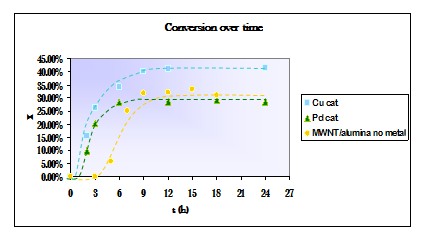 In addition, this reaction may be of relevance for other applications in Petroleum Engineering, such as reservoir characterization. If the molecules produced by partial oxidation are soluble in water, the catalytic reaction could be employed to produce chemical tracers which would be detected when the injected water is recovered in the wellbore. Then, by identifying and quantifying these chemical tracers, information about the composition and location of the oil in the reservoir could be inferred.
Although the primary application of this system is in Petroleum and Reservoir Engineering, alternative areas on which this system is of interest exist. For example, tetralone (main product of the oxidation of tetralin) is used to industrially obtain 1- naphthol and 2-methyl-1-naphthol [3] and other products such as insecticides, agricultural chemicals and drugs [4].
References:
[1] Fletcher, A. and Davis, J. SPE 129531 presented at the SPE Symposium on Improved Oil Recovery, Tulsa, Oklahoma, USA, 24 – 28 April 2010.
[2] Weissman, J. Fuel Processing Technology 50 (1997) 199.
[3]Yuranov et al. Applied Catalysis A: General 226 (2002) 193
[4] Holden et al. Journal of Chemical Education 82 (2005) 934.



Collaborations among:
