
To be considered for the Sooner Works program, applicants must meet the following criteria:
Have a documented intellectual disability (ID) as defined by the American Association on Intellectual and Developmental Disabilities (AAIDD) and have received special education services with an IEP in high school.
Have completed high school and no longer be receiving K–12 services.
Be between the ages of 18–26 at the start of the program.
Serve as their own legal guardian (or obtain guardianship status before program start).
Be independent in handling daily living needs, including medication, dietary, toileting, hygiene, feeding, and dressing.
Demonstrate at least a 3rd grade reading level in comprehension and fluency.
Demonstrate basic math skills and the ability to use a calculator.
Be able to communicate consistently with others. This may include the use of assistive technology, but the student must be able to independently operate that technology.
Have sufficient emotional and independent stability to participate in all aspects of the program, including:
Attending 90-minute academic courses.
Functioning independently for at least one-hour blocks of time.
Navigating campus safely (streets, parking lots, and public spaces).
Adapting to changes in schedule, environment, or staffing without becoming overly distressed.
Demonstrate a desire to complete the Sooner Works program and adhere to program policies regarding attendance, participation, and conduct.
Express motivation to obtain inclusive employment upon completion of the program.
Actively participate in all parts of the application and interview process
Behavioral & Safety Standards
Motivation & Follow-Through
Developing vs. Non-Negotiable Skills
Accuracy of Application Materials
Because space in the program is limited, meeting the eligibility criteria does not guarantee an interview or admission to Sooner Works.
APPLICATION STEPS
The application process is designed to give students the opportunity to demonstrate their readiness, independence, and motivation for the Sooner Works program. Each step provides insight into how applicants approach responsibilities, navigate challenges, and engage in a college environment.
Before beginning the application, applicants should gather the documents that will be uploaded as part of the online application.
Required documents include:
Most recent Individualized Education Program (IEP)
Most recent psychological evaluation
Applicants may also include optional materials that demonstrate independence or initiative, such as:
Verification of work, volunteer, or practicum experience
Attendance or participation records from the past year
IEP transition planning documents
Resumes, certificates, or other accomplishments
Preparing these materials in advance will make the application process smoother.
Applicants will submit two personal statements that help the admissions committee learn more about the student’s goals, independence, and readiness for the Sooner Works experience.
Video Introduction (up to 3 minutes)
Applicants will record a short video introducing themselves. Students may choose to share:
What a typical day looks like for them
Examples of things they handle independently
A time they faced a challenge and how they worked through it
Why they are interested in the Sooner Works program
Written Essay (350–500 words)
Applicants will also submit a written personal statement describing:
Why they want to attend Sooner Works
A recent goal they set and achieved
How they manage responsibilities and challenges
The supports they expect to use at OU while remaining actively involved in their own success
Both personal statements should reflect the student’s own voice and experiences.
The application includes:
Personal and contact information
Educational background
Skills and independence inventory
Uploading supporting documents
Submission of personal statements
Estimated time to complete the application is 60–90 minutes.
Application timeline:
Application Opens: October 1, 2026
Early Action Deadline: December 1, 2026
Regular Decision Deadline: February 1, 2027
Two online recommendation forms are required. At least one recommender must have directly supervised the applicant in the past 12 months (e.g., teacher, counselor, job coach, supervisor).
The form includes:
A brief Personal Support Inventory
Ratings and examples of: initiative, punctuality, persistence, behavior in unstructured settings, and openness to feedback
Short concrete examples (2–3 sentences each)
Applicants waive the right to view completed recommendations to allow for honest feedback.
Once applicants complete the online application, they will receive a link to the recommendation form. Applicants should inform their recommenders in advance about the form’s purpose and encourage timely submission.
After the application and supporting materials have been reviewed, selected applicants will be invited to participate in a first-round virtual interview with the student and a panel of Sooner Works representatives.
This conversation helps the admissions committee learn more about the student’s goals, interests, and readiness for the Sooner Works experience. The interview also provides an opportunity for applicants to ask questions and learn more about the program.
Applicants who advance to the next stage will be invited to participate in an interview experience at the University of Oklahoma.
During this experience, the student will participate in discussions and short activities that reflect everyday college responsibilities. These activities help us better understand how students approach independence, organization, and problem-solving.
Examples may include:
Reviewing a sample weekly schedule and discussing how they would manage time for classes, studying, work, and activities
Identifying campus resources and how they might use them
Entering a commitment into a planner or phone calendar
Sending a short follow-up email summarizing next steps
Families will also have an opportunity to discuss how they support the student’s independence while respecting the student’s autonomy and decision-making.
After the interview process is complete, the Sooner Works admissions committee will review all materials and determine final admissions decisions.
Admissions decisions are based on several factors, including:
Alignment with the Sooner Works independence model
Evidence of motivation, initiative, and follow-through
Feedback from recommendations and interview activities
Available space in the incoming cohort
Students who are recommended for admission will receive information outlining the next steps for enrolling at the University of Oklahoma, including:
Completing university admission requirements
Securing housing
Registering with the Accessibility & Disability Resource Center
Preparing for the transition to campus life
ESTIMATED COST OF ATTENDANCE
Sooner Works is designed to provide an inclusive college experience, with costs comparable to those of traditional University of Oklahoma students. The costs listed below are estimates and subject to change. Please note that the structure of program fees and tuition may evolve in response to new legislation and emerging financial assistance opportunities at both the state and national levels.
| Item | Estimated Total |
Resident Tuition and Hourly Mandatory Fees Average of 7 credit hours of OU coursework per semester, varying by individual plan of study. This does not include the additional program activities that make up full-time status (e.g., internships, skills labs). | $2,300 |
Sooner Works Program Fee Fixed cost that supports program operations, individualized advising, skills labs, daily study sessions, career and employer coordination, family communication, specialized technology (e.g., EQUIP), and dedicated support staff across academics, career readiness, independent living, and campus engagement. | $6,000 |
College Technology and Program Fees Variable cost contingent on course selection. | $1,200 |
|
Variable cost. First-year Sooner Works students have guaranteed housing, providing an integrated residential experience and allowing Sooner Works staff to offer regular support (e.g., dorm checks). After the first year, students are encouraged to secure off-campus housing, with program approval, which may reduce cost. | $6,055 |
|
Variable cost contingent on student’s selection. | $3,165
|
Books/Supplies Variable cost contingent on course selection. | $150
|
Estimated Semester Total (Fall 2026): $18,870
Estimated Academic Year Total (2026-2027): $37,740
| Item | Estimated Total |
Non-Resident Tuition and Hourly Mandatory Fees Average of 7 credit hours of OU coursework per semester, varying by individual plan of study. This does not include the additional program activities that make up full-time status (e.g., internships, skills labs). | $7,000 |
Sooner Works Program Fee Fixed cost that supports program operations, individualized advising, skills labs, daily study sessions, career and employer coordination, family communication, specialized technology (e.g., EQUIP), and dedicated support staff across academics, career readiness, independent living, and campus engagement. | $6,000 |
College Technology and Program Fees Variable cost contingent on course selection. | $1,200 |
|
Variable cost. First-year Sooner Works students have guaranteed housing, providing an integrated residential experience and allowing Sooner Works staff to offer regular support (e.g., dorm checks). After the first year, students are encouraged to secure off-campus housing, with program approval, which may reduce cost. | $6,055 |
|
Variable cost contingent on student’s selection. | $3,165
|
Books/Supplies Variable cost contingent on course selection. | $150
|
Estimated Semester Total (Fall 2026): $23,570
Estimated Academic Year Total (2026-2027): $47,140
FINANCIAL AID
Students in Sooner Works may access a variety of financial aid options, including federal aid, state-funded support, and private scholarships. Funding varies by student and should be explored early in the planning process.
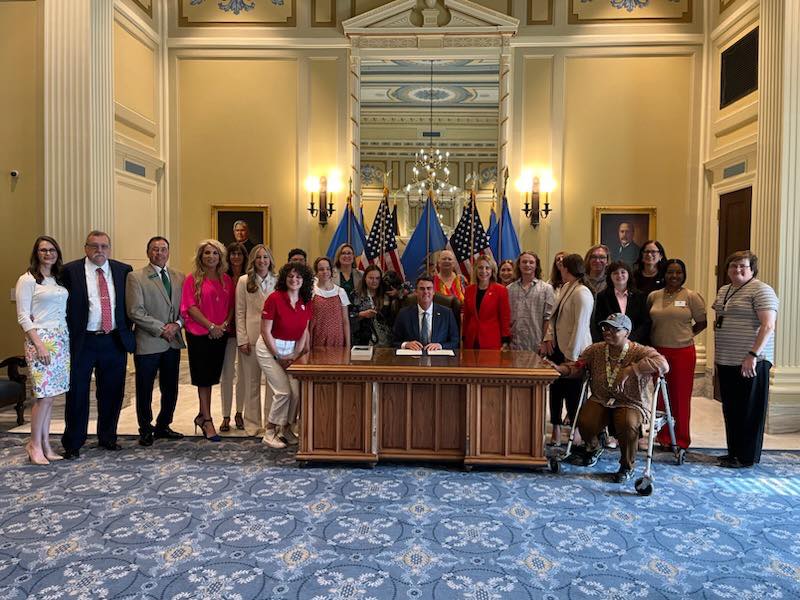
Sooner Works joined partners from across Oklahoma at the State Capitol for the signing of House Bill 3792, which established the Oklahoma Access and Achievement Scholarship Program. This legislation expanded financial support for students with intellectual and developmental disabilities pursuing college. Pictured: Sooner Works Director Dr. Barritt alongside advocates, educators, and legislators who supported this legislation.
While federal financial aid is not always available for non-degree programs, Sooner Works is recognized by the U.S. Department fo Education as a Comprehensive Transition and Postsecondary (CTP) program, making students eligible for certain elements of FAFSA, including:
Many Sooner Works students receive financial support through state-funded vocational rehabilitation (VR) programs. These programs are designed to help individuals with disabilities prepare for, obtain, and maintain competitive, integrated employment. For students in Oklahoma, this support is typically provided through the Oklahoma Department of Rehabilitation Services (DRS). Students from other states may access similar services through their state’s vocational rehabilitation agency (e.g., Texas Workforce Commission), but this is determined by state policy and individual vocational rehabilitation counselors. When approved, vocational rehabilitation funding may help cover costs related to participation in the Sooner Works program as determined by the counselor. Students must apply for vocational rehabilitation services and be determined eligible through their state agency. Once registered, students work with a VR counselor to develop an individualized plan for employment, which outlines their goals and the types of services and supports that may be funded.
Important considerations:
The Oklahoma Access and Achievement Scholarship is a state-funded program designed to support students with intellectual disabilities who are enrolled in Comprehensive Transition Programs (CTPs), including Sooner Works. The scholarship can help reduce the cost of attendance for eligible Oklahoma residents.
Students may qualify if they:
For full eligibility details, visit the official Oklahoma Access and Achievement Scholarship webpage: Oklahoma Access and Achievement Scholarship Program
In addition to federal and state financial aid, students may explore a variety of private scholarships and external funding sources to support their college experience.
Private Scholarships
Students may be eligible for scholarships specifically designed for individuals with intellectual and developmental disabilities, including:
Students are encouraged to explore these and other local or national scholarship opportunities each year.
National Resources & Guides
The following resources from Think College provide helpful guidance on funding options for students with intellectual disabilities:
Families are encouraged to explore multiple funding sources and begin the application process early, as timelines and eligibility requirements vary.
