GCA Communications intern Kathlyn Dannewald (K) spoke with Grace Olaleye (G), who was recently named deputy manager of risk-based estimating for the Mega Mobility Investment Program at HNTB. She is also an alumna of the Master of Construction Science program at Gibbs College of Architecture. We sat down with Ms. Olaleye to discuss her job as part of the Program Management Consultants for Georgia Department of Transportation (GDOT), and how she got into construction science. Read on for highlights or click the link below to access the full podcast.
K: Hello, everyone, welcome to the Gibbs Spotlight. My name is Kathlyn Dannewald, and I’m a communications intern at the Gibbs College of Architecture.
Today we are speaking with Grace Olaleye, an alumna of the Master of Construction Science program. Grace, who now lives in Atlanta was recently named deputy manager of risk-based estimating for the Mega Mobility Investment Program at the HNTB Corporation, a nationwide infrastructure firm.
Thank you so much for joining us today, Grace. So, to get started, can you share a little bit about your background? What originally attracted you to construction science?
G: Caitlin. It is Kathlyn. Right? Yeah. We just talked about that. Okay. Thanks for having me.
What attracted me to construction science? I was at a point in my life, where I think, this is actually a really cool interview to do because this was a point in my life as a woman where I was having to make a decision as to how I was going to take care of myself and my son. And I was looking for a higher degree, something that would put me in a position to be able to take care of us.
And I have brothers who are in the project management world. And my brother was like, ‘Hey, listen, you need to get into project management and look into PMP.’ And I was like, ‘Okay, let me look into the PMP.’ PMP for those who don’t know is the Project Management Professional material. It’s a course that once you get the credentials, it can boost your salary, because you’re basically a qualified Project Management Professional at that point. When you’re studying for the PMP, they actually tell you to think of any sort of project because it can apply to any field. It can apply to IT, it can apply to construction, whatever. So, my brothers are in IT, but interestingly enough, I had a very successful short real estate career.
And my project that I began to think of when studying for the PMP was construction. It just came naturally, and what’s interesting is, as I began to study for the construction project management portion, I was driving down Lindsay, and I saw a huge banner that said, “Come try our Master’s in Construction Management.” And I’m like, oh, that sounds like something I should do. So, it was the banner, life situations, and everything just kind of aligning that led me to choose construction science as the next step.

Olaleye with OU Women in Construction visiting the First Americans Museum site.
K: Thank you so much for sharing that. That’s so interesting. I’ve never heard of PMP. I’ll have to look into it.
G: Yeah, it’s definitely worth it. I will say, the longer that I’ve been working in my environment, in the world that I work in, even if you don’t get the certification, it’s worth knowing how to manage a project efficiently. You can literally take it to, ‘well I’m just going to use this to plan parties.’ You will be like the best party planner there is like seriously, so yeah, it’s definitely worth looking into.
K: So, you mentioned the banner, but were there any other reasons you chose the OU Master’s program?
G: Well, I will say, he is no longer at OU, but Dr. Perrenoud. He was an associate professor at the time. And when I came in, a little follow-up story to the seeing the banner. I call the university and of course, I was like, let me pursue a second bachelor’s because it seems like this construction science thing is very specialized. I’m not trying to go over and above anybody. I just want to learn so it was like, ‘let me get a second bachelors.’ And David, I cannot remember his last name, is the undergrad liaison, and I went to his office, and he was like, “Wait, hold on, you already have a bachelor’s degree. You need to go talk to our graduate liaison.”
It was Dr. Perrenoud at the time. And I told Dr. Perrenoud my story, ‘Hey, I’m trying to find out a way to be able to take care of myself and my son. I had a very successful real estate career, I know a little bit about construction, and it interests me.’ I’ll never forget, and it was probably one of the most important moments that have ever happened in my life, and I don’t even know if he remembers it. But he leaned back, folded his arms across his chest, and he looked at me and he said, “Grace, I believe you would be an asset to this industry, and I would love for you to apply.” And I’m like, “Wait, what? Me?” Like, he doesn’t know how much hope he gave me in that moment.
And that was enough to say, ‘hey, keep going.’ So, it was definitely a combination of life’s events, and then having a professor who was in position to receive new students, look at me as someone who could be a value to the industry. That made OU my choice.

Grace Olaleye and her son Xavier on game day.
K: That’s really awesome. Yeah, I’m not in Gibbs College, but everyone I’ve interacted with there has just been amazing and really encouraging.
G: I like to call it Hogwarts. I love the fact that Dean Hans is like Dumbledore to me.
K: He’s just so amazing. They’re just so great. I’ve taken a lot of courses in the college, and just all the professors are just really awesome.
G: Yeah, it’s pretty cool, and they’re pretty cool, too.
K: So, once you were in the program, what was your experience like? And how did it help prepare you for your career?
G: Oh, it was hard as hell.
K: That’s what everyone says.
G: It was definitely survival of the fittest. It felt like Hunger Games at times. Legit. It’s construction, they definitely give you a taste for what’s going to happen in the industry, not in a, ‘oh, my gosh, it’s terrifying’ kind of way, but the industry is very traditional. The industry is very, ‘this is how it’s always been done. Don’t come in here with your city slicker new stuff and try and change.’ Like, there’s definitely a system to be followed. And I think the program really gave me a taste of that and helped me understand that there’s definitely some challenges that will come as far as being part of the construction industry.
But I will say it really whipped me into shape for what it is that I do right now, in the construction industry. I will shout out Dr. Ghosh at this moment, because he played a really big role in just how I began to become more disciplined in how I was using Excel and how that course in particular really shaped how I would perform in my career. So, it was survival of the fittest. It was good, sometimes it was beautiful. It was fun, sometimes it was scary, but it was a very interesting experience.
But I will say if I could do it all over again, ‘hell yeah, let’s do it!’ And I know some people that know what I went through would be like, ‘Yo, she’s insane.’ I would say for what I do right now, when I look back, especially the sort of environment that I’m in where it’s a $26 billion program, and they don’t just choose new people to come work on the program. And there’s a lot of mentalities that feel that way too. And I will say, OU definitely helped me build some muscle to be able to handle what I’m handling.

One of Grace Olaleye's graduation photos.
K: Can you share a little bit more about your current career and job, like what led you to your current position and stuff like that?
G: Yeah, sure. I needed an internship to be able to graduate. And I started interning at HNTB in 2019. And I was always interested in program controls, and so I had a heavy interest in estimating and was immediately placed into the program controls group. And first rotation was with the cost group, which was like, ‘oh my gosh, I don’t know why anyone in the world would want to be an accountant. This is the most horrible thing ever.’ I was having to do all kinds of Excel formulas to look for pennies and like this is insane. I don’t want to do this.
But I will say it again added another layer to my sophistication on use of Excel. Which led me to the next rotation which was with my current, boss and mentor, Dr. Ovidiu Cretu. And he actually developed what is called the Risk Based Estimating Self-Modeling Spreadsheet that utilizes a Monte Carlo algorithm. What is interesting about this risk-based estimate is that it builds on top of the deterministic estimate, so it’s basically like, your estimate on steroids, let’s just put it that way.
Basically, you have your project cost, and this is if the project were to work as planned, here’s what it would cost. And then you have your risk-based estimate, which says, ‘Well, now that we have identified and quantified risk, here’s what it’s going to actually cost you in terms of cost and schedule.’ So anyway, that’s how I started my next rotation. And it was like, ‘Oh, my goodness, I really, really, really liked this.’ And it was another opportunity for me to leave school.
I don’t know what it is about me loving the torture of education. But it was another opportunity for me to get out of school, and I called it residency in my mind. That’s the way I’ve looked at it. People get out of school and go to medical school and go into residency. So, this was my way of saying, ‘Oh, I get to get out of school and actually do something really, really cool and learn from the man who actually developed it.’ So that’s kind of how I got into doing the risk-based estimate. Did I answer your question? Or did I go down a rabbit hole?

Olaleye giving a presentation about her internship experience.
K: You definitely answered it. Thanks for sharing, I think we’re going to see more of what you do when you take over our Instagram account.
G: I look forward to sharing.
K: Yeah, in January, that’ll be super cool. I’m sure a lot of the construction science students will be excited to tune in and hear more.
G: I would love them to because we’re recruiting.
K: HNTB is huge, and I’m pretty sure anyone in the college could find some niche there.
G: We are definitely recruiting and if Atlanta’s the city you love, holler at your girl!

Grace Olaleye and an intern from the University of Texas assigned to her at HNTB.
K: Do you have any advice for those Construction Science students or just students in general at Gibbs?
G: Keep going. Just keep going. Our industry is not easy. It’s not an industry where people just have to accept what you give. You’re literally designing people’s lives and how they function, how they move through their home, how they move through the world, how they view the world, the beauty that they see in the world. And there’s something that clearly attracted each and every student to want to be part of the built environment.
And I think you have got to earn your stripes. And I think it’s worth it. Because again, we really are the ones who design people’s lives. I don’t know if every student realizes that about Gibbs College of Architecture. I mean, you’ve got your construction. Yeah, we don’t have heavy civil [engineering], but we’ve got the construction managers, so we’ve got your construction people. You’ve got your design people, you’ve got your landscape design people, you’ve got your planners. There’s all the landscape architecture. We literally are touching every aspect of what people see. And I don’t know if you’ve noticed, but we’re so small. We’re not a big college. It’s a small college that has made a huge impact.
Keep going. There’s this book I’m reading, and the main characters are at this dinner, and at the dinner, there are invisible plates that come out. The plates are dancing, kind of like a Harry Potter thing. The plates are dancing to the tables to be given to the people at the dinner. And the main characters are like, ‘Wait, where are these plates coming from?’ And then the host says, “Well, they’re the invisible helpers, they know their job, they know their role.’ Sometimes I feel like that’s us; we’re so small, and not everybody understands what we do. Not everybody is attracted to what we do, but we’re the invisible helpers.
Keep going, keep doing you. Keep bringing your ideas. Don’t stop. So that’s my advice. Keep going. As long as you feel like you’re called to this, all I can say is keep going.

Olaleye as a student at an awards banquet with Dean Hans E. Butzer.
K: Okay, awesome. Definitely good advice, especially after we just finished finals.
G: Please keep going. I know, especially after you have had anxiety all holiday long. Jesus Christ. I don’t miss that at all. And I’m sorry you guys are experiencing that, but yeah, I don’t miss that at all!
K: Do you have any specific advice for young women entering the field of construction science?
G: Be you. And I think that I am a very different-looking construction science student. Not only am I a Black woman who’s 5’ 2”, who looks like she’s 20-something. I like my heels, and I like really nice, beautiful dresses. I am very, very feminine in my appearance and just my demeanor and everything.
So, do I look like your typical construction professional? God no. But do we have a place there? Absolutely. And I’m realizing that more and more. There’s a place in leadership for our femininity. There’s a place in leadership for the style in which we communicate, how we present ourselves, how we’re able to communicate results of what it is that we’ve done. And that is not just at the leadership level. You could be at entry level, and still, the fact that you present yourself in that ultra-feminine way, there’s a magic to it, that men just don’t have. They cannot ever get it. They can try, but it’s just not possible.
There’s just this energy to being a woman that we should not shy away from. I’m very big on encouraging young women. And hey, depending on however you present as a female, that’s you. But for me, I present more feminine, definitely very different than your typical construction worker. And I want to say there’s a place for us, and we should not shy away from being ourselves.
And then speak up. Speak up more than once. Speak up again if you have to. Sometimes it may seem as if we’re ruffling feathers, that’s because we are. We’re supposed to. Things would not change if we didn’t ruffle some feathers. And it can get scary. It can get intimidating, because you feel like, ‘Should I be saying these things? Should I be doing these things?’ And truth be told, you should. As long as it’s not affecting the job. As long as it’s not affecting the project. If it’s something that affects your role in how you do your job and how you add value to the project of the program, please speak up because there’s people coming behind us. There’s young women coming.
Let me tell you one thing. They don’t know anybody from OU other than me in my company. But I think I have been the one to hold the microphone and be like, ‘Hey, y’all are not ready for these students.’ Because I am looking at just how we are. And it’s just very interesting, but I would say there is a place for us. And I will tell you that I’m part of an organization called WTS, and they’re women that are actively fighting for us and making ways to make sure that we are represented in the way that we should be. So anyway, that’s my advice for young women.

Olaleye speaking at the Women in Transportation National Conference in Seattle, WA.
K: Awesome. Thank you so much for sharing. I think that’s great advice for any young woman, not even just in construction science. Especially with self-advocacy. It is so important. And learning to stand up for yourself can be scary, but it’s so important.
G: Very important. And I’ll add one more thing. With the women in construction, or just any industry, it’s really important for you to speak up. For you to be present. I cannot emphasize it any more than I already have. I’m noticing there’s so many gaps where if women knew they could be in that position, if women knew that that position was even a thing, they would be in the industry, and they could bring so much value. I didn’t even think communications was a huge thing for the transportation industry. Oh my god!
The program that I’m on, its branding, and I’m big on branding. So, I’m the one that goes to the communications department. And I’m like, ‘I want to see. What are the color codes? What are the slides that you want us to use?’ Like what is the program branding? And just looking at what our communications director does, in terms of just the branding, and just how consistent it is on all platforms, I’m telling you, there’s just so much in the construction industry, not only just for women who were trained in construction, but even just other parts of it that we need to be filling these gaps.
K: Thank you so much for sharing. Is there anything else you wanted to share with our listeners today? That was my last question.
G: I’m just happy that I got the opportunity to do this. Gibbs College of Architecture holds a very special place in my heart, and I am forever grateful that I went through the program. The relationships that I have built through that program will last forever. The experiences that I had will last forever. It wasn’t all perfect, but I can honestly say I have seen the silver lining in everything. So just want to say thank you for allowing me or even just thinking of me to do this for you guys. It’s really been an honor.
K: Thank you so much for taking the time to interview with us today and then help us out with the Instagram takeover later. I’m sure everyone will be very excited to watch. I will be watching the day that happens. Thank you again for taking the time to join us on the Gibbs Spotlight.
G: Thank you. Take care!
K: Thanks again for listening to the Gibbs Spotlight. Tune in next time to hear more stories from the Gibbs College of Architecture.
This transcript has been edited for clarity and length.
Gibbs College is pleased to present the exhibition 200 Digital Drawings by Professor Tiziana Proietti, currently on display in the Gould Hall Living Room.
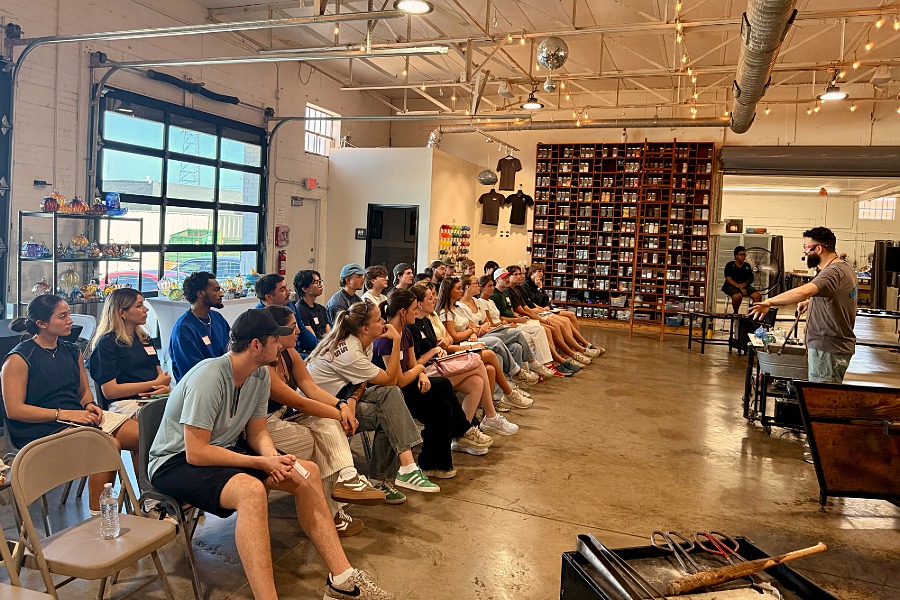
Gibbs College of Architecture Professors Amber Brown and Amy Leveno led 29 students to Dallas, Texas, in September for a learning experience as part of their Design 7 Studio course.
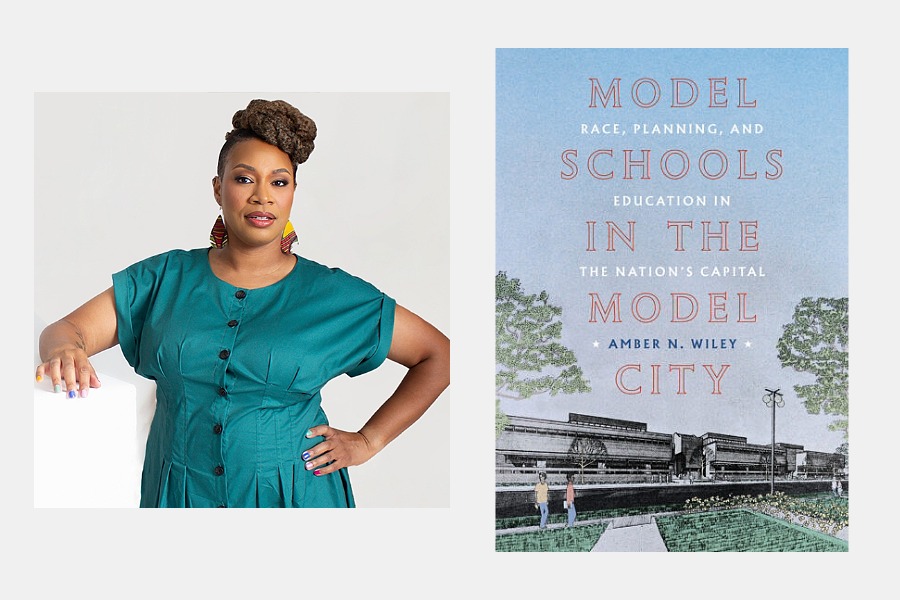
Christopher C. Gibbs College of Architecture professor and Institute for Quality Communities Director Dr. Amber N. Wiley’s book, Model Schools in the Model City: Race, Planning, and Education in the Nation’s Capital, has received two major honors from the Urban History Association.