NEWS


NORMAN, OKLA. – Microbes in the soil play a crucial role in climate warming by affecting the release and absorption of greenhouse gases. Wei Qin, an assistant professor of microbiology at the University of Oklahoma, has received an Early Career Award from the U.S. Department of Energy to examine how these bacteria and microorganisms impact the way nitrogen changes and moves through soil environments.
“This award was a big surprise as it has traditionally been given to recognize early career scientists in chemistry and engineering at OU,” he said. “But it is also exciting because, as an environmental microbiologist, my research focuses on the interrelations between microbiology, biogeochemistry and climate change in both marine and soil ecosystems.”
Qin previously received funding from the National Science Foundation for research on nitrogen in ocean settings and will lead a scientific cruise in the North Pacific in the summer of 2025. This award, however, will focus on nitrogen cycling in grassland soil environments.
Using data from the OU Kessler Atmospheric and Ecological Field Station and the Institute for Environmental Genomics, his team will examine how climate change factors can lead to environmental problems, like the release of nitrous oxide, a powerful greenhouse gas, into the atmosphere, as well as nitrate leaching from soils, which causes groundwater contamination.
“The long-term experimental warming site at Kessler has existed for 15 years but mainly focuses on big ecological questions. I was able to leverage this experimental site and archived historical data to propose this research that focuses on the greenhouse gasses and nitrogen nutrient transformation,” he said.

If successful, Qin’s research will help better understand how climate change, specifically warming temperatures and changing rainfall patterns, affects these microorganisms and the cycle by which they move between the soil and the atmosphere.
Director of the OU School of Biological Sciences Jeff Kelly added, "This award is a wonderful recognition of Dr. Qin's important work on interactions of microorganisms, the nitrogen cycle and climate warming. This research will leverage OU's unique infrastructure for long-term warming experiments maintained by the Institute for Environmental Genomics that enable Dr. Qin to address such critical environmental issues with global impact."
Qin is one of 91 early career scientists from 50 universities and 12 Department of Energy national laboratories to receive a combined $138 million in funding. Learn more about the Early Career Award and about the QinLab at the University of Oklahoma.
About the project
Qin’s project, “Investigating the interactive impact of long-term warming and altered precipitation on grassland nitrifying communities,” will receive $875,000 from the Office of Biological and Environmental Research and the U.S. Department of Energy’s Established Program to Stimulate Competitive Research. This project began in July 2024 and is expected to conclude in June 2029
About the University of Oklahoma
Founded in 1890, the University of Oklahoma is a public research university located in Norman, Oklahoma. As the state’s flagship university, OU serves the educational, cultural, economic and health care needs of the state, region and nation. For more information about the university, visit www.ou.edu.
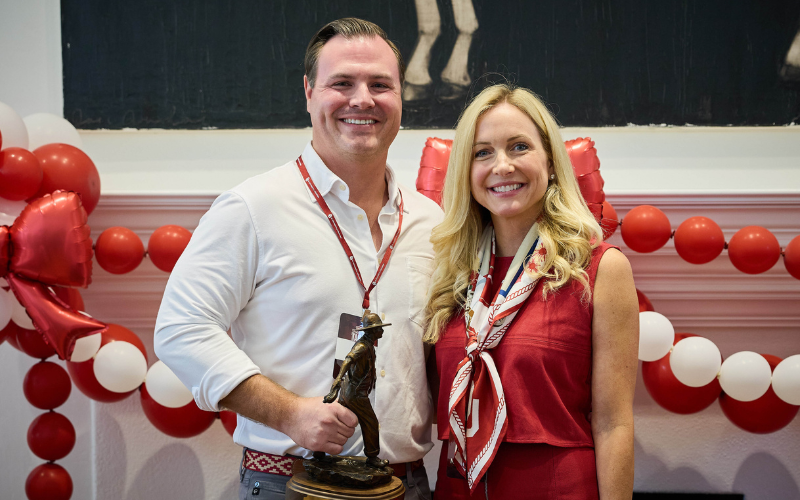
The University of Oklahoma has received a transformative gift from Jon and Shannon McCartney, which will name the McCartney Family Tunnel of Champions, the McCartney Family Gate of the Gaylord Family - Oklahoma Memorial Stadium and the McCartney Family Grand Lecture Hall in the Michael F. Price College of Business. The gift will also support the Inspiring Champions and the Athletic Director’s Discretionary Fund, in addition to establishing the McCartney DFW Career Trek program at Price College.
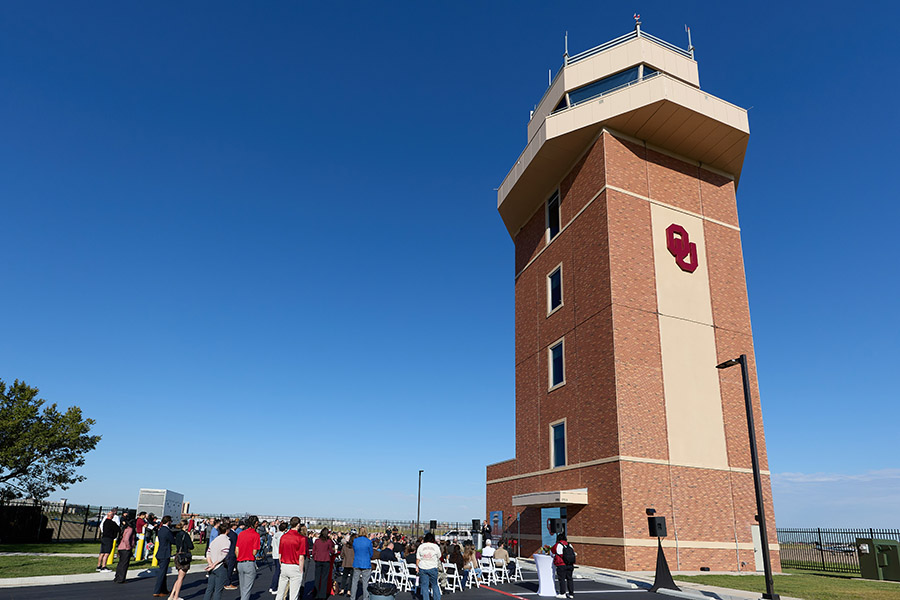
The University of Oklahoma today celebrated the opening of a new air traffic control tower at the OU Max Westheimer Airport. Standing 106 feet tall, more than double the current 52-foot facility, the new tower will modernize air traffic control operations and improve safety for pilots and students operating in the airspace.
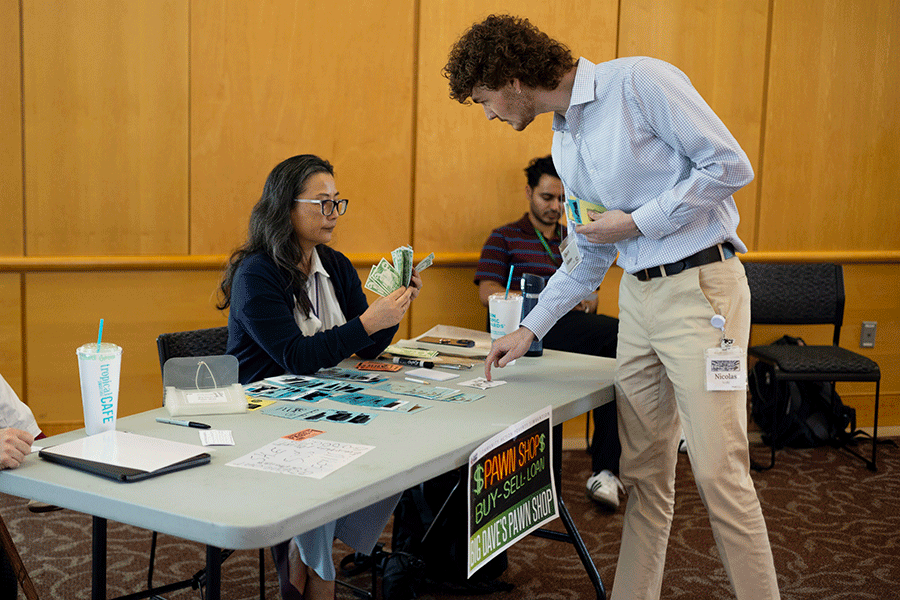
Do I buy groceries or pay the electric bill? Should I pawn some of my belongings to afford my prescription? My child is sick, so I will have to miss work to take care of him. Those are just a few of the difficult choices that OU-Tulsa health professional students confronted during the Community Access to Resources Experience. The role-playing activity challenged students to navigate the financial, family and other pressures that can affect a person’s health and ability to follow medical advice. Held annually during the SCM Institute orientation week, the experience is designed to generate understanding and build empathy.