NEWS


NORMAN, Okla. – The University of Oklahoma is experiencing a period of transformation few institutions in higher education can match – but OU President Joseph Harroz Jr. says the university’s progress is less a finish line than a foundation for what comes next.
Speaking at State of the University addresses last week on OU’s Norman and Health campuses, Harroz reflected on the university’s remarkable progress over the past five years, pointing to record enrollment, a transformed academic health system, rapidly growing research activity, and much more.
Together, he said, those achievements have positioned OU to confront some of Oklahoma’s most pressing needs while navigating a moment of considerable change for higher education nationally.
“We at OU are having a moment,” Harroz said. “We are counter to what is taking place [across the nation.]”
Harroz delivered the addresses at both events hosted by the Faculty and Staff Senates on the two campuses.
Five Years of Transformation
Harroz framed OU’s progress against a dramatically different picture just five to six years ago. Enrollment had remained around 31,000 students for roughly a decade, the university faced significant financial challenges, and Oklahoma had yet to establish a fully integrated academic health system.
Today, OU is approaching 40,000 students – a milestone Harroz said the university is on track to surpass next year. This fall marked OU’s sixth consecutive record freshman class and fourth straight record for Oklahoma freshman students, with the size of the incoming class growing 45% in six years. Among Oklahoma freshmen in this year’s class, 37% are first-generation students.
Growth is also accelerating at the Health Campus, which has increased enrollment by more than 31% in six years and surpassed 4,000 students for the first time – reversing a 7% enrollment decline from 2015 to 2020.
At the same time, OU’s research enterprise has grown by 70% in six years, with annual research expenditures more than doubling from approximately $250 million to $550 million, and ambitions to reach $1 billion by 2031.
That trajectory is being accelerated through Project 200, OU’s historic investment to recruit approximately 200 new research faculty across areas of strategic importance to Oklahoma and the nation. Of those, 150 will be concentrated on the Health Campus, dramatically expanding OU’s capacity for biomedical discovery and research-based care. The Health Campus also recently broke into the nation’s Top 100 for NIH funding for the first time.
Building an Academic Health System
Perhaps nowhere is OU’s transformation more visible than in the emergence of its academic health system.
Five years ago, OU made what Harroz described as a major bet: that combining education, research, and clinical care could create a system capable of elevating health across Oklahoma. Since then, OU Health has grown from approximately $1.4 billion in annual revenue to approaching $4 billion, while annual patient visits have increased from approximately 650,000 annually to more than 1 million. The system has also substantially improved its financial performance, with support flowing from the clinical enterprise to OU’s academic mission now exceeding $100 million annually, fueling the education and research that, in turn, drive better care.
The transformation is also expanding access to research-based care across the state, including cancer care in Oklahoma City, Norman, McAlester, and Tulsa. Construction of a 175,000-square-foot Stephenson Cancer Center facility is under way in Tulsa, alongside other major investments in pediatric behavioral health and heart care.
“We made this bet that we could do something that hadn’t been done in our state before and create a fully integrated academic health system,” Harroz said – one built ultimately “to lift the health of a population that deserves it and needs it.”
A Strategy Behind the Momentum
Harroz noted that OU’s progress is not the result of any single initiative or individual. Rather, he attributed the university’s trajectory to its people, a clear institutional purpose, and disciplined execution of OU’s Strategic Plan.
Now in its sixth year, the plan aligns the university around a single purpose – We Change Lives – supported by five pillars, defined strategies, and measurable goals. Just as importantly, OU’s budget and leadership priorities are directly aligned with those goals.
Harroz said OU’s approach begins with listening and being honest about the university’s strengths and challenges, and then bringing discipline to what happens next.
That focus has helped earn confidence beyond the university. Harroz pointed to record fundraising – with OU nearing completion of its historic $2 billion campaign – and unprecedented levels of partnership with state and federal leaders. In recent years, those partnerships have generated hundreds of millions of dollars in investments supporting priorities ranging from new research and teaching facilities to cancer care, pediatric behavioral health, the future pediatric heart hospital, and other major initiatives. This year alone, OU secured approximately $178 million in federal support.
Accountability and Shared Governance
Harroz also emphasized that accountability is essential to maintaining – and continuing to earn – the public’s trust in higher education.
He pointed to the work OU has already undertaken in areas including post-tenure review, regular review of endowed positions, and merit-based raises as examples of the university’s willingness to hold itself accountable while preserving the principles of shared governance.
That work will continue this year through a Presidential Advisory Council on Accountable Shared Governance, which will examine how OU can further strengthen shared governance and demonstrate that the university community is willing to hold itself to meaningful standards.
At a time when institutions across the country are facing growing scrutiny over shared governance and tenure, Harroz said OU has chosen to confront difficult questions directly – an approach he believes can distinguish the university nationally and help preserve the public’s confidence in higher education.
“We can’t just say we’re better at it,” he said. “We have to demonstrate it and be accountable.”
Preparing for the AI Era
Harroz also identified artificial intelligence as one of the most consequential opportunities – and challenges – facing OU.
Rather than viewing AI solely through the lens of academics, he said the university must develop a comprehensive approach spanning teaching, research, health care, and the work of faculty and staff.
OU is in the early stages of building that framework, drawing on expertise from across the university while also engaging outside leaders with experience navigating technological change at scale.
“We can’t just boil the ocean on AI,” Harroz said. The immediate task, he added, is to create a structure for determining where OU should focus and how the university can approach a transformational technology thoughtfully and purposefully.
What Comes Next
For Harroz, the most important question is not what OU has accomplished. It is what the university will do with the strength it has built.
As one of the nation’s relatively small number of public flagship research universities – and one of even fewer with a comprehensive academic health system – OU has a unique responsibility to expand educational opportunity, improve health, and strengthen economic prosperity.
That means continuing to grow research, providing an education that is both excellent and affordable, and pursuing ambitious goals for lifting Oklahoma’s health outcomes. It also means adapting as new challenges and opportunities emerge while remaining anchored to the university’s fundamental purpose and Strategic Plan.
Harroz described OU’s progress over the past five years as “proof of concept” for what is possible, not the completion of the work.
“We have to earn this every single day,” he said.
The university, he said, is now positioned to move with a speed and ambition that would have been difficult to imagine just five years ago. And for Harroz, that is the real significance of OU’s current moment: not simply the progress already made, but the opportunity it has created to do more.
“This is that moment,” he said. “And I think we’re the group that can be up to that.”

About the University of Oklahoma
Founded in 1890, the University of Oklahoma is a public research university located in Norman, Oklahoma. As the state’s flagship university, OU serves the educational, cultural, economic and healthcare needs of the state, region and nation. For more information about the university, visit www.ou.edu.
A newly funded study at the University of Oklahoma aims to increase prostate-specific antigen (PSA) screening among Black men in Oklahoma, who die from prostate cancer at rates two to four times higher than other racial groups.
Young adults who want to quit vaping may turn to social media for support, but keeping them engaged with digital cessation programs over time can be challenging. A University of Oklahoma researcher is testing whether adding support from trained peers can help keep young adults engaged as they try to quit vaping.
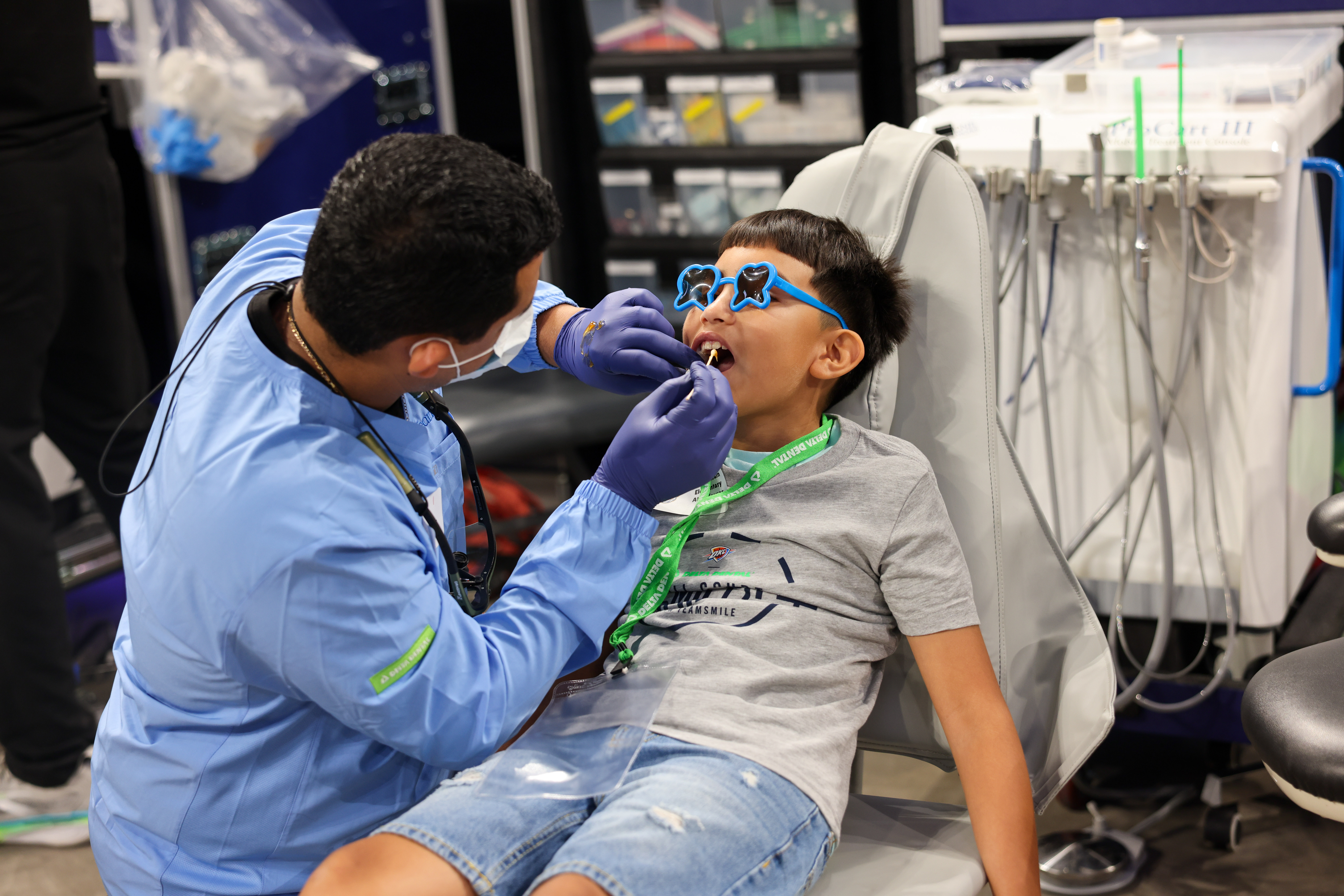
For 259 third- and fourth-graders from Oklahoma City Public Schools, a trip to the Paycom Center recently came with something more than a chance to see the home of the Oklahoma City Thunder. During the inaugural Full Court Smiles event, the students received $82,315 in free dental care from faculty, residents and students from the University of Oklahoma College of Dentistry and other dental professionals.