NEWS


By
Greg Bruno
Date
Media Contact
Kat Gebauer
kathryngebauer@ou.edu
NORMAN, Okla. – As instigators of immunity, monoclonal antibodies are marvels of modern medicine, lab-made proteins that can treat cancers, autoimmune diseases, and many other conditions. With the market for these therapies forecast to double by 2030, it might seem that the only thing they can’t do is grow fast enough.
New research from the University of Oklahoma aims to put an end to that limitation, too.
In a study published in the journal Communications Engineering, Chongle Pan, an OU professor of computer science and biomedical engineering, and Penghua Wang, a doctoral student in data science and analytics, detail a machine learning model that dramatically accelerates the manufacturing timeline of monoclonal antibodies.
“We’re trying to solve a key bottleneck in the biomanufacturing production process,” said Wang. “It’s all about getting to market faster.”
In humans, antibodies are produced by white blood cells known as B cells, but in biomanufacturing, the job falls to Chinese hamster ovary cells (CHO), the industry standard for producing therapeutic antibodies.
Pan said the process isn’t that dissimilar to making beer. In fermentation, yeast feeds on sugars that are converted to alcohol. Similarly, harvested CHO cells feed on nutrients designed to maximize antibody production.
Yet not every cloned cell line produces antibodies at the same rate; productivity is varied. To select cell lines with the highest yield, biomanufacturers must screen the cultured samples, a phase of production that can take several weeks. Reducing this timeline is a priority for drug companies and could help lower the cost of medicines for patients.
Pan and Wang hypothesized that cell productivity can be predicted using growth data acquired in earlier stages of production. To test their theory, they partnered with Oklahoma City-based Wheeler Bio, a contract development and manufacturing organization (CDMO) focused on antibody therapies. Wheeler provided production data, which was combined with an established mathematical equation – the Luedeking-Piret model, which describes how cells grow and produce proteins – to train and validate machine learning tools.
After testing and fine-tuning, the researchers’ model correctly selected higher-performing clones in 76.2% of its trials and accurately forecast daily production trajectories from day 10 through day 16, using only data collected during the first nine days of growth. The results, Pan and Wang wrote, demonstrate the validity of a “simulated real world clone selection” that will eventually enable “more rapid and confident identification of high-performing clones.”
More testing and model training is needed before the model could be put into Wheeler’s production processes, Pan said. But company officials said they are encouraged by the early results.
“Wheeler Bio is committed to leveraging artificial intelligence and machine learning to accelerate our approach to cell line development and process development for antibody therapeutic production,” said Patrick Lucy, President and CEO of Wheeler Bio.
“This foundational work is the first step in Wheeler’s strategic commitment to leverage artificial intelligence and machine learning to further enhance our ModularCMC™ platform.”
The research was part of a $35 million program funded by the U.S. Economic Development Administration to expand the biotechnology industry cluster in the Oklahoma City region. OU’s Gallogly College of Engineering and the recently opened OU Bioprocessing Core Facility are key institutions in that initiative, which is designed to combine academic innovation with industrial application.
“In academia, we tend to pursue theoretical research,” Pan said. “But this study, and our partnership with Wheeler Bio, gave us an opportunity to apply machine learning and data science expertise to a real-world problem that the industry faces.”
About the project
The research is funded by the U.S. Department of Commerce, Economic Development Administration, Award No. 087905677. The paper, “Luedeking-Piret regression for multi-step-ahead forecasting and clone selection in monoclonal antibodies biomanufacturing,” can be found at https://doi.org/10.1038/s44172-025-00547-7
About Wheeler Bio
Wheeler Bio is a contract development and manufacturing pioneer who has established the ModularCMC™ platform that enables the rapid translation of antibody-based therapeutics from discovery to clinical studies while ensuring scalability in support of advanced development and commercialization. ModularCMC streamlines the path between drug discovery and clinical manufacturing through well-defined systematic work packages ultimately resulting in cGMP product supported by a comprehensive Common Technical Document (CTD) Module 3 for Investigational New Drug Applications (INDs). Wheeler's High Science/High Touch approach combines cutting edge development and cGMP manufacturing technologies with a deeply experienced scientific team committed to timeline transparency, scientific rigor and a true partnering mindset. Wheeler Bio's mission is to accelerate the translation of drug discoveries into clinical impact for our partners and the patients they seek to serve.
About the University of Oklahoma
Founded in 1890, the University of Oklahoma is a public research university located in Norman, Oklahoma. As the state’s flagship university, OU serves the educational, cultural, economic and health care needs of the state, region and nation. OU was named the state’s highest-ranking university in U.S. News & World Report’s most recent Best Colleges list. For more information about the university, visit ou.edu.
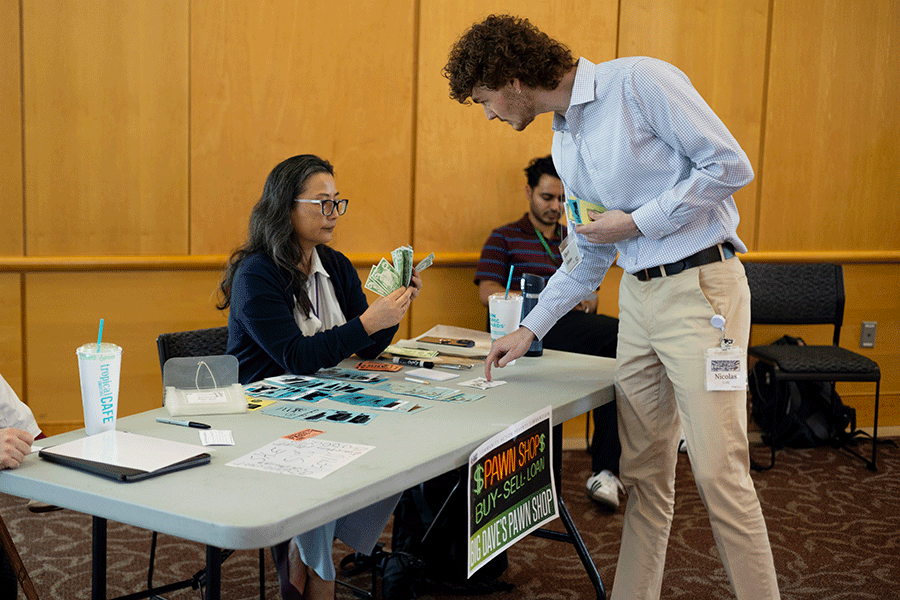
Do I buy groceries or pay the electric bill? Should I pawn some of my belongings to afford my prescription? My child is sick, so I will have to miss work to take care of him. Those are just a few of the difficult choices that OU-Tulsa health professional students confronted during the Community Access to Resources Experience. The role-playing activity challenged students to navigate the financial, family and other pressures that can affect a person’s health and ability to follow medical advice. Held annually during the SCM Institute orientation week, the experience is designed to generate understanding and build empathy.
Thanks to more than $5 million in funding through a National Institutes of Health initiative, the University of Oklahoma's College of Nursing will support four maternal health research projects over the next four years.
A University of Oklahoma physician-researcher recently received $2.9 million in funding from the National Cancer Institute to study whether RedHill Biopharma’s drug opaganib, given after CAR T-cell therapy, can help the immune cells fight cancer more effectively.