NEWS


NORMAN, Okla. – Across the Earth, about 40% of land is covered by grasslands. These regions support food and economic security worldwide and locally underpin Oklahoma’s row crop operations, and livestock, transportation and tourism industries. However, these ecosystems face ongoing changes and threats to their survival. To address these challenges, a team of researchers headquartered at the University of Oklahoma is taking an innovative approach toward advancing grassland conservation and management.
The team has established the Center for Grassland Ecosystem Forecasting (CGEF), led by researchers from the University of Oklahoma, Oklahoma State University, the Noble Research Institute and East Central University. Xiangming Xiao, Ph.D., who holds a George Lynn Cross Research Professorship in OU’s School of Biological Sciences, is the project’s principal investigator and the center’s director.
This summer, the U.S. National Science Foundation awarded Xiao’s team a four-year, $8 million grant to establish the center. The funding is made possible through the NSF’s EPSCoR Research Incubators for STEM Excellence (E-RISE) program, which emphasizes research proposals with a high potential impact in emerging or interdisciplinary research areas.
While grasslands provide essential goods and services to human communities, they are also vulnerable to large spatial-temporal variability driven by weather, such as heatwaves and droughts, as well as fires, cattle grazing and human activities. This makes accurately predicting and forecasting grassland ecosystem dynamics a significant challenge.
Timothy Filley, Ph.D., center co-director and professor in OU’s School of Geosciences and Department of Geography and Environmental Sustainability, said that global food production demands have contributed to the degradation of grasslands. For example, as farming has suppressed the frequency of fires that manage grasslands, there are now more woody plants such as Eastern Redcedar trees that are invading the regions.
“Nearly 140 years of intensive and extensive land use have resulted in severe degradation of Oklahoma’s grassland soils,” said Filley, who is also the director of OU’s Stable Isotope Measurement Facility. “The good news is that we have learned, and in many cases re-learned, what it takes to rebuild and maintain resilient soils.”
“Across the state, regenerative practices are now at the forefront of many land managers’ programs,” Filley added. “The question we’re addressing through the center is, how can science predict the changing condition of grasslands quickly enough to help guide real-world decisions?”
To improve adaptative grassland ecosystem forecasting, which is an underdeveloped field, the CGEF team will establish in-situ multi-scale observatories at OU’s Kessler Atmosphere and Ecological Field Station, where grassland areas have been invaded by Eastern Redcedar tree. They will also operate observatories with the USDA ARS Oklahoma and Central Plains Agricultural Research Center, in El Reno, Okla., where native tallgrass prairie and pasture co-exist.
At these sites and at partner institutions and ranches, the researchers will collect long-term data of soil, microbes, plant diversity and forage quality, the weather, and the exchange of carbon, nitrogen and water between the lands and the atmosphere. The CGEF will also work to develop a statewide observatory to measure, monitor, report and verify grassland ecosystem dynamics in the state.
The center will combine the updated data, advanced models and artificial intelligence/machine learning to create ranch digital twins. These virtual replicas of grassland ecosystems will let researchers simulate how grasslands respond to different management practices and policies under Oklahoma’s highly variable weather.
Through analyses of simulation results, the researchers and community members will work together to assess the likely impacts of proposed management practices and scenarios on the grasslands they manage. This would help them weigh the likely effects of their options, from implementing regenerative grazing practices to controlling woody plant encroachments.
“Many decisions by ranchers require data and information from the past, present and near future,” Xiao said. “Grassland ecosystem forecasting would provide timely and actionable data and information to ranchers and other stakeholders.”
Beyond supporting those who work on the grasslands, the CGEF will strengthen STEM workforce development and provide valuable experience for undergraduate and graduate students and postdoctoral researchers. The team will also partner with additional stakeholders who steward Oklahoma’s grasslands, including the Oklahoma Conservation Commission, ranchers and tribal nations, to develop and support a community of practice in grassland ecosystem forecasting.
“Oklahoma’s economy is deeply tied to the health of our grasslands,” Filley said. “Our biggest goal is translating complex scientific data into practical, actionable forecasts and tools that ranchers and land managers can use every day. Our partners and practitioners will be essential to that goal.”
Along with external support, the center is fueled by collaboration across OU’s campus. The team will draw on expertise and facility support from the Mewbourne College of Earth and Energy, the Dodge Family College of Arts and Sciences, the College of Atmospheric and Geographic Sciences and the Office of the Vice President for Research and Partnerships.
Xiao noted that the E-RISE program is structured to provide a second three-year phase of research funding after the first four-year phase, pending the approval of a future follow-up proposal.
“We began to test how you can do this at a very local scale,” said Xiao, adding that the CGEF is built on work ongoing since 2013. “All of these long-term experiments and observations helped us to build a strong case in this center proposal. We are now ready to tackle this grand challenge across multiple organizational scales from ecosystems to ranches, watersheds, and the state.”
About the project
“Center for Grassland Ecosystem Forecasting” is funded by an $8 million grant from the U.S. National Science Foundation’s EPSCoR Research Infrastructure Improvement Program: EPSCoR Research Incubators for STEM Excellence, Award No. 2546641.
About the University of Oklahoma
Founded in 1890, the University of Oklahoma is a public research university located in Norman, Oklahoma. As the state’s flagship university, OU serves the educational, cultural, economic and healthcare needs of the state, region and nation. For more information about the university, visit www.ou.edu.
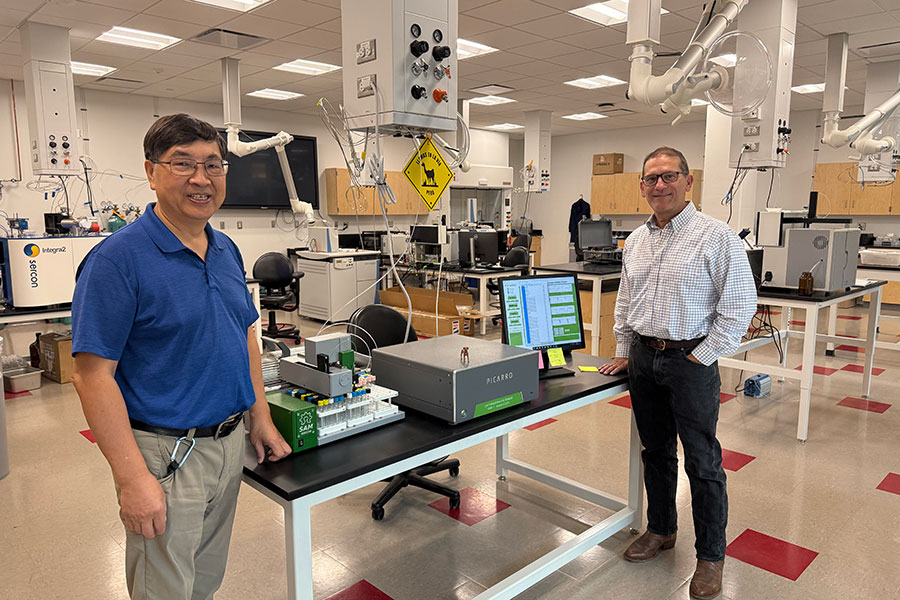
A team of researchers headquartered at the University of Oklahoma is taking an innovative approach toward advancing grassland conservation and management, with grant support from the the U.S. National Science Foundation. The project brings together experts and observatory sites from across the state.
Dorothy A. Rhoades, M.D., M.P.H., has been recognized for her impact on improving Native American health outcomes. She was honored by the Association of American Indian Physicians at its 54th Annual Meeting & Health Conference.
New research from the University of Oklahoma shows how unusual atmospheric conditions linked to tropical cyclones can contribute to compound extreme heat and ground-level ozone pollution, even far from the storm, increasing risks to human health.